- Understanding Website Speed and Core Web Vitals in 2026
- Introduction Why Website Speed Matters More Than Ever in 2026
- What Are Core Web Vitals in Simple Terms
- Why Core Web Vitals Are Important for SEO and Business Growth
- Common Reasons Websites Become Slow in 2026
- Introduction to Website Speed Optimization Tools
- Most Important Categories of Speed Optimization Tools
- Basic Comparison of Speed Optimization Tool Categories
- Why Businesses in Australia Focus on Speed Optimization in 2026
- Best Speed Optimization Tools and Practical Performance Improvements
- Introduction to Speed Optimization Tools in Real Use
- Performance Testing Tools for Core Web Vitals
- How These Tools Improve Website Speed
- Image Optimization Tools for Faster Loading
- Real Impact of Image Optimization
- Caching Tools for Faster Website Performance
- Why Caching Matters for Core Web Vitals
- Code Optimization Tools for Advanced Speed Improvement
- How Code Optimization Improves Performance
- Hosting Optimization Tools and Their Role
- Why Hosting Affects Core Web Vitals
- Before and After Optimization Impact
- ROI Business Impact Trends Strategy and Final Verdict
- Introduction to the Business Value of Website Speed
- ROI of Website Speed Optimization in 2026
- Business Impact of Core Web Vitals in Australia
- Common Mistakes Businesses Make in Speed Optimization
- Future Trends of Website Speed Optimization 2026 to 2030
- Strategic Approach to Speed Optimization in 2026
- Final Verdict
- Author Information
Understanding Website Speed and Core Web Vitals in 2026
Introduction Why Website Speed Matters More Than Ever in 2026
In 2026, website speed is one of the most important ranking and performance factors in the digital world. In Australia, Ireland, the United States, and other top-tier digital markets, businesses are no longer judged only by design quality or content. They are judged by how fast their websites load and how smoothly users can interact with them.
Users today expect instant results. If a website takes more than a few seconds to load, most visitors leave immediately and move to a competitor. This behavior has made speed optimization a critical part of web development and digital marketing strategy.
Search engines also prioritize fast websites. A slow website not only loses users but also loses visibility on Google. This means lower traffic, fewer conversions, and reduced revenue.
Because of this, understanding website speed optimization and Core Web Vitals has become essential for businesses, developers, and digital marketers in 2026.
What Are Core Web Vitals in Simple Terms
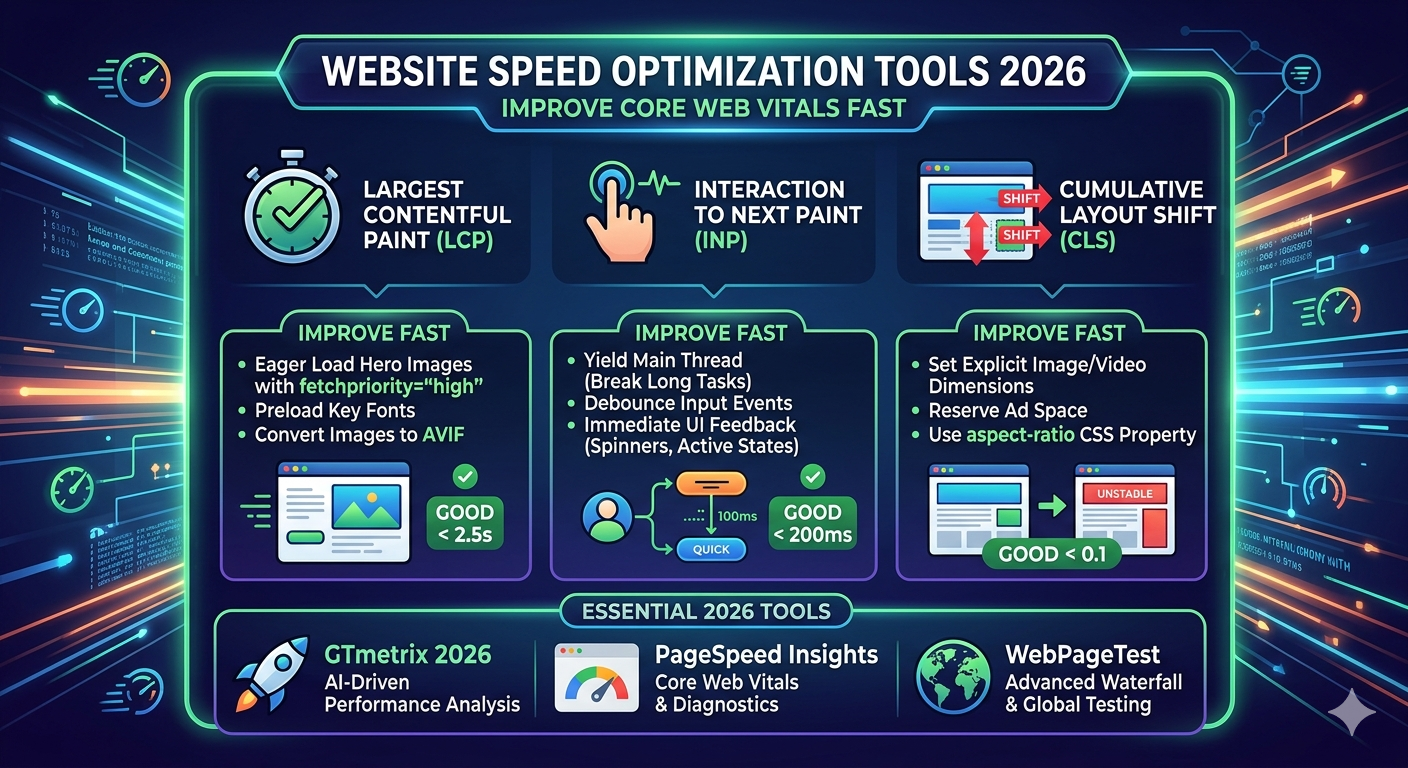
Core Web Vitals are a set of performance metrics introduced to measure the real user experience of a website. Instead of focusing only on technical speed, these metrics focus on how users actually experience loading, interaction, and visual stability.
There are three main Core Web Vitals that matter most:
1. Largest Contentful Paint
This measures how long it takes for the main content of a page to load. If a website loads its main content quickly, users feel the site is fast and responsive.
2. First Input Delay
This measures how quickly a website responds when a user interacts with it, such as clicking a button or opening a menu. A lower delay means better interactivity.
3. Cumulative Layout Shift
This measures how stable the page layout is while loading. If elements move around unexpectedly, it creates a poor user experience.
Together, these three metrics determine how users perceive website performance in real time.
Why Core Web Vitals Are Important for SEO and Business Growth
In 2026, Core Web Vitals are not just technical indicators. They are directly connected to search engine rankings and business performance.
Search engines use these metrics to evaluate user experience. A website that performs well on Core Web Vitals is more likely to rank higher in search results compared to a slower competitor website.
From a business perspective, faster websites lead to better engagement. Users are more likely to stay longer, explore more pages, and complete actions such as making purchases or filling out contact forms.
Even a small improvement in loading speed can significantly increase conversion rates. For eCommerce businesses, faster websites often lead to higher sales because customers do not abandon their shopping journey due to delays.
Common Reasons Websites Become Slow in 2026
Understanding why websites become slow is the first step in improving performance. In modern web development, there are several common reasons behind poor speed performance.
One of the biggest causes is unoptimized images. Large image files take longer to load and significantly slow down page performance.
Another common issue is poor hosting quality. Websites hosted on low performance servers often struggle to deliver content quickly, especially during high traffic periods.
Too many scripts and plugins also affect speed. Many websites load unnecessary JavaScript files or third party tools that increase loading time.
Lack of caching is another major issue. Without proper caching systems, websites must reload all content every time a user visits.
Finally, poor coding structure can also reduce performance. Unclean or outdated code increases processing time and slows down rendering.
Introduction to Website Speed Optimization Tools
Website speed optimization tools are designed to analyze, measure, and improve website performance. These tools help developers and businesses identify issues that slow down their websites and provide recommendations for improvement.
In 2026, these tools have become more advanced. Many of them now use artificial intelligence to automatically detect performance issues and suggest optimized solutions.
These tools are widely used by developers, SEO professionals, and businesses in Australia and other competitive markets because they provide actionable insights without requiring deep technical knowledge.
Most Important Categories of Speed Optimization Tools
Website speed tools can be divided into different categories based on their purpose.
Performance Testing Tools
These tools measure how fast a website loads and identify performance bottlenecks.
Image Optimization Tools
These tools compress and optimize images to reduce file size without losing quality.
Caching Tools
These tools store website data temporarily to improve loading speed for returning users.
Code Optimization Tools
These tools help clean and optimize CSS, JavaScript, and HTML files.
Hosting Performance Tools
These tools evaluate server speed and hosting quality to ensure optimal performance.
Basic Comparison of Speed Optimization Tool Categories
| Tool Category | Main Function | Impact on Speed | Usage Level |
|---|---|---|---|
| Performance Testing | Analyze speed metrics | High | Easy |
| Image Optimization | Reduce file size | Very high | Easy |
| Caching Tools | Store website data | High | Medium |
| Code Optimization | Clean website code | Very high | Advanced |
| Hosting Tools | Improve server response | High | Medium |
Why Businesses in Australia Focus on Speed Optimization in 2026
In Australia, digital competition has increased significantly across industries such as eCommerce, real estate, education, and SaaS platforms. Because of this, website performance has become a major competitive advantage.
Businesses that invest in speed optimization tools often see better search rankings and improved user engagement. Faster websites also reduce bounce rates, which means more users stay on the site and interact with content.
Another reason for increased focus on speed is mobile usage. Since most users access websites through mobile devices, fast loading times are essential for retaining mobile visitors.
Australian businesses also prioritize speed because it directly affects advertising performance. Slow landing pages reduce conversion rates and increase marketing costs.
Best Speed Optimization Tools and Practical Performance Improvements
Introduction to Speed Optimization Tools in Real Use
In 2026, website speed optimization is no longer handled manually in isolation. Businesses in Australia, Ireland, the United States, and other top digital markets rely heavily on automated tools that analyze performance, detect issues, and recommend improvements in real time.
These tools are essential because modern websites are built with complex frameworks, high resolution media, third party integrations, and dynamic content systems. Without proper optimization tools, it becomes very difficult to maintain strong Core Web Vitals scores.
This section focuses on the most effective tools used in real world scenarios and how they directly improve website performance.
Performance Testing Tools for Core Web Vitals
Performance testing tools are the foundation of speed optimization. They help measure how fast a website loads, how stable it is, and how quickly it responds to user interactions.
These tools simulate real user experiences and provide detailed reports on Core Web Vitals metrics.
Common Performance Testing Tools in 2026
| Tool Name | Main Purpose | Best Feature | Usage Level |
|---|---|---|---|
| Google PageSpeed Insights | Core Web Vitals analysis | Real Google data | Beginner |
| GTmetrix | Speed and load analysis | Waterfall breakdown | Beginner to intermediate |
| Lighthouse | Technical performance audit | Deep diagnostics | Advanced |
| WebPageTest | Real world speed simulation | Multi location testing | Advanced |
How These Tools Improve Website Speed
Performance tools do not directly speed up a website but identify exactly what is slowing it down. This allows developers and businesses to focus on fixing specific issues instead of guessing.
For example, if a website has slow loading times due to large images, these tools will clearly highlight image optimization as a problem. If JavaScript is blocking rendering, the tool will show script execution delays.
This level of detail makes performance optimization more structured and efficient.
Image Optimization Tools for Faster Loading
Images are one of the biggest causes of slow websites. In modern web design, high quality visuals are essential, but they must be optimized properly to avoid performance issues.
Image optimization tools reduce file size without significantly affecting quality. This improves loading speed and Core Web Vitals scores, especially Largest Contentful Paint.
Popular Image Optimization Tools
| Tool Name | Function | Advantage | Best Use Case |
|---|---|---|---|
| TinyPNG | Image compression | High quality reduction | General websites |
| ImageOptim | Lossless compression | No quality loss | Professional use |
| Squoosh | Google tool | Advanced control | Developers |
| ShortPixel | Automatic optimization | Bulk processing | eCommerce sites |
Real Impact of Image Optimization
Proper image optimization can reduce website size by 40 percent to 80 percent depending on the original files. This has a direct impact on loading speed, especially for mobile users.
In Australia, where mobile browsing is dominant, optimized images significantly improve user experience and reduce bounce rates.
Caching Tools for Faster Website Performance
Caching is one of the most powerful methods to improve website speed. It works by storing a version of the website so that it does not need to reload completely every time a user visits.
Caching reduces server load and improves response time, which directly improves Core Web Vitals scores.
Common Caching Tools
| Tool Name | Type | Main Benefit | Platform |
|---|---|---|---|
| WP Rocket | Plugin | Easy setup caching | WordPress |
| W3 Total Cache | Plugin | Advanced caching control | WordPress |
| Cloudflare | CDN and caching | Global speed improvement | All websites |
| LiteSpeed Cache | Server level caching | High performance boost | Hosting based |
Why Caching Matters for Core Web Vitals
Caching improves First Input Delay and Largest Contentful Paint by reducing server response time. When content is already stored, users receive faster access to pages.
For high traffic websites in Australia, caching is essential because it ensures consistent performance even during peak traffic periods.
Code Optimization Tools for Advanced Speed Improvement
Code optimization focuses on improving how efficiently a website loads and executes scripts. This is one of the most technical areas of speed optimization but also one of the most impactful.
Key Code Optimization Tools
| Tool Name | Function | Benefit Level | User Type |
|---|---|---|---|
| Minify JS Tools | Reduce script size | High | Developers |
| CSSNano | CSS optimization | High | Advanced users |
| Terser | JavaScript compression | Very high | Developers |
| PurgeCSS | Remove unused styles | High | Frontend developers |
How Code Optimization Improves Performance
Code optimization reduces unnecessary files, removes unused code, and compresses scripts. This helps browsers load websites faster and reduces rendering delays.
It also improves Cumulative Layout Shift by ensuring that elements load in a structured and predictable manner.
Hosting Optimization Tools and Their Role
Hosting plays a critical role in website speed. Even a perfectly optimized website will perform poorly if hosted on slow servers.
Hosting Performance Tools and Platforms
| Hosting Tool | Type | Speed Impact | Best For |
|---|---|---|---|
| SiteGround | Managed hosting | High | Small to medium businesses |
| Cloudways | Cloud hosting | Very high | Scalable websites |
| AWS Performance Tools | Enterprise hosting | Maximum | Large applications |
| Kinsta | Premium WordPress hosting | High | Professional websites |
Why Hosting Affects Core Web Vitals
Hosting determines server response time, which directly impacts Largest Contentful Paint. A slow server increases loading time regardless of design optimization.
In 2026, businesses in Australia are increasingly moving toward cloud based hosting solutions to ensure better performance and scalability.
Before and After Optimization Impact
| Factor | Before Optimization | After Optimization |
|---|---|---|
| Page Load Time | 5 to 8 seconds | 1 to 3 seconds |
| Bounce Rate | High | Significantly reduced |
| Core Web Vitals Score | Poor | Good to excellent |
| User Engagement | Low | High |
| Conversion Rate | Weak | Improved |
Speed optimization tools work best when used together rather than individually. Performance testing identifies issues, image tools reduce file size, caching improves delivery, code optimization improves structure, and hosting ensures stability.
Together, they create a complete ecosystem that significantly improves Core Web Vitals and overall website performance.
ROI Business Impact Trends Strategy and Final Verdict
Introduction to the Business Value of Website Speed
In 2026, website speed is no longer just a technical performance metric. It has become a direct business growth factor in competitive markets like Australia, Ireland, the United States, and other top-tier digital economies. Companies are realizing that even a one-second delay in loading time can significantly affect user behavior, conversion rates, and search engine rankings.
Speed optimization is now considered a core part of digital strategy rather than a backend technical task. Businesses that invest in improving Core Web Vitals are seeing stronger engagement, better SEO performance, and higher revenue compared to competitors with slower websites.
This final part focuses on real business impact, return on investment, future trends, and strategic approaches to speed optimization in 2026.
ROI of Website Speed Optimization in 2026
The return on investment from website speed optimization is one of the most measurable in digital performance. Unlike many marketing activities that take time to show results, speed improvements often deliver immediate benefits.
When a website becomes faster, users stay longer, interact more, and are more likely to complete actions such as purchases, form submissions, or bookings. This directly increases revenue without increasing traffic costs.
In eCommerce businesses, even small improvements in load time can significantly increase sales. Faster checkout pages reduce cart abandonment rates and improve customer satisfaction.
For service based businesses, improved speed leads to more inquiries and higher trust levels. Users perceive fast websites as more professional and reliable.
| Improvement Area | Before Optimization | After Optimization | Business Impact |
|---|---|---|---|
| Page Load Time | 5 to 7 seconds | 1 to 3 seconds | Higher retention |
| Conversion Rate | Low to medium | Medium to high | Increased revenue |
| Bounce Rate | High | Reduced significantly | Better engagement |
| SEO Ranking | Weak | Improved | More organic traffic |
Business Impact of Core Web Vitals in Australia
In Australia, Core Web Vitals have become a major ranking and performance factor for businesses competing in digital markets. Search engines now prioritize user experience signals, making speed optimization essential for SEO success.
Businesses that fail to meet Core Web Vitals standards often experience lower visibility in search results, even if their content is high quality. This makes performance optimization just as important as content creation.
Industries such as real estate, eCommerce, healthcare, education, and SaaS are especially impacted because they rely heavily on user interaction and online conversions.
Fast websites also improve brand perception. Users associate speed with professionalism, reliability, and trustworthiness. This psychological impact plays a key role in customer decision making.
Common Mistakes Businesses Make in Speed Optimization
Despite the availability of advanced tools, many businesses still make mistakes when optimizing website speed. One of the most common mistakes is focusing only on one aspect of performance instead of a complete optimization strategy.
For example, some businesses only compress images but ignore server performance or code efficiency. This leads to limited improvements rather than full optimization.
Another mistake is using too many plugins or third party scripts. While these tools add functionality, they often slow down the website if not managed properly.
Poor hosting choices are also a major issue. Many businesses choose low cost hosting without considering performance impact, which leads to slow server response times.
Finally, some businesses ignore mobile optimization. Since most users access websites through mobile devices, ignoring mobile performance significantly reduces overall effectiveness.
| Mistake | Impact | Solution |
|---|---|---|
| Partial optimization | Limited improvement | Full strategy approach |
| Too many plugins | Slow performance | Reduce unnecessary tools |
| Poor hosting | Slow response time | Upgrade hosting |
| No mobile focus | Lost users | Mobile first design |
Future Trends of Website Speed Optimization 2026 to 2030
Website speed optimization is expected to evolve significantly in the coming years. One of the biggest trends is the integration of artificial intelligence into performance monitoring tools.
AI will be able to automatically detect performance issues and fix them without manual intervention. This will make speed optimization faster and more efficient.
Another major trend is real time optimization. Websites will automatically adjust performance based on user device, location, and network speed.
Edge computing is also becoming more important. This technology allows content to be delivered from servers closer to the user, reducing latency and improving loading times.
Web design frameworks are also becoming more lightweight, focusing on performance first development rather than heavy visual elements.
| Future Trend | Expected Benefit |
|---|---|
| AI optimization | Automatic performance improvements |
| Real time adaptation | Personalized speed optimization |
| Edge computing | Faster global access |
| Lightweight frameworks | Better Core Web Vitals scores |
Strategic Approach to Speed Optimization in 2026
For businesses in 2026, the most effective strategy is a layered approach to speed optimization. This means combining multiple tools and techniques rather than relying on a single solution.
The first step is performance analysis using tools that measure Core Web Vitals. This helps identify specific issues affecting the website.
The second step is asset optimization including images, scripts, and code structure. This improves loading efficiency.
The third step is server and hosting optimization to ensure fast response times.
The final step is continuous monitoring and improvement because website performance is not a one time task but an ongoing process.
| Step | Action | Purpose |
|---|---|---|
| Step 1 | Performance analysis | Identify issues |
| Step 2 | Asset optimization | Improve speed |
| Step 3 | Hosting optimization | Reduce latency |
| Step 4 | Monitoring | Maintain performance |
Final Verdict
Website speed optimization in 2026 is one of the most important factors for online success. It directly impacts user experience, SEO rankings, conversion rates, and overall business growth.
Core Web Vitals are now a standard measure of website quality, and businesses that ignore them risk losing visibility and customers. On the other hand, businesses that invest in speed optimization tools gain a strong competitive advantage.
The best results come from combining multiple optimization techniques including performance testing, image compression, caching, code optimization, and reliable hosting.
In conclusion, website speed is not just a technical improvement. It is a strategic business decision that influences long term success in the digital market.
Author Information
This article is written by Hannah Smith, a digital performance and web optimization specialist with over ten years of experience in SEO strategy, website performance engineering, and conversion optimization. She has worked with businesses across Australia, Ireland, and international markets to improve Core Web Vitals performance and enhance digital user experience.
Her expertise focuses on helping businesses achieve faster websites, better search engine rankings, and higher conversion rates through practical, data driven optimization strategies.

[…] Read More […]