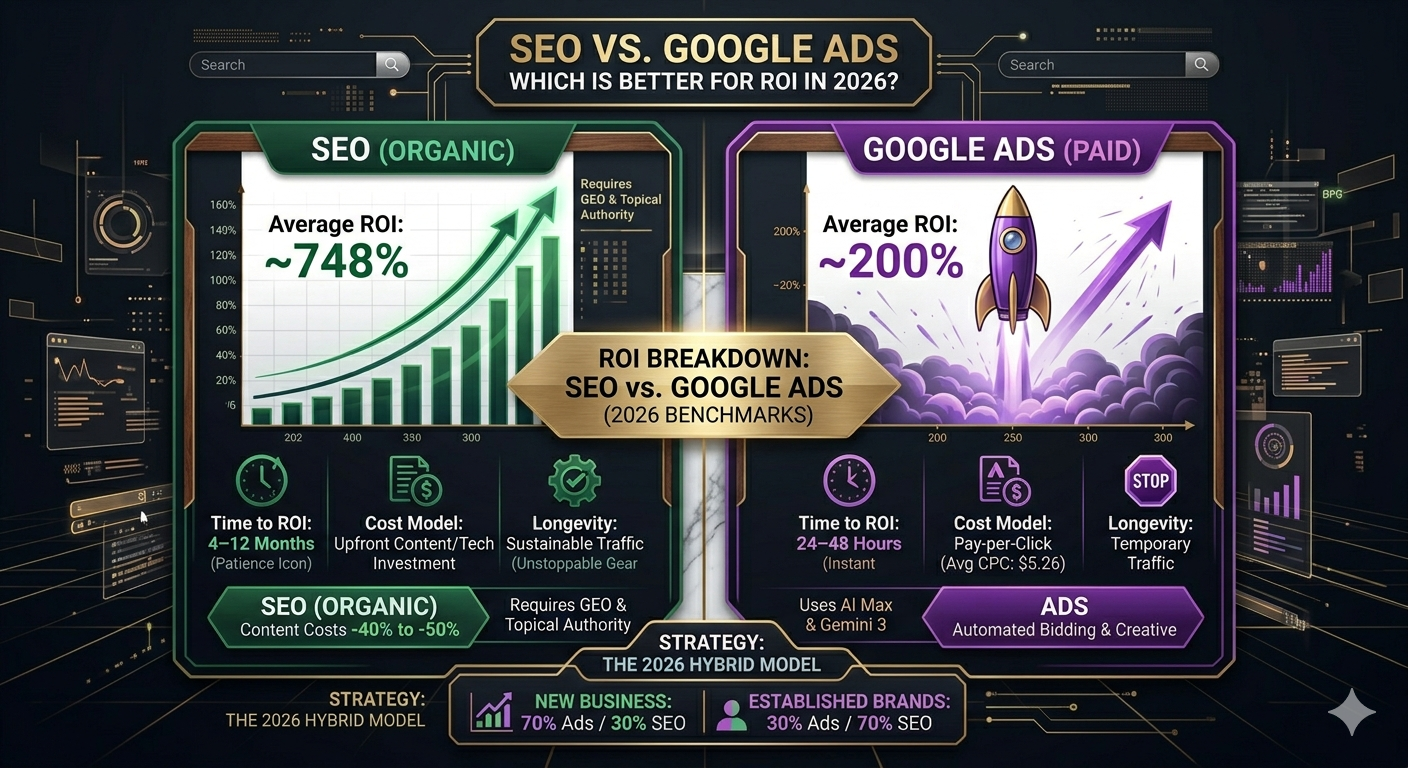
- 1. Introduction — The Real Marketing War in 2026
- 2. What is SEO? (Deep Breakdown)
- 3. What is Google Ads? (Deep Breakdown)
- 4. Evolution of SEO vs Ads (2010 → 2026 Deep Insight)
- 5. Core Differences Between SEO and Google Ads
- 6. How SEO Works in 2026 (Deep System Breakdown)
- 7. How Google Ads Works in 2026 (AI-Powered System)
- 8. SEO Cost vs Google Ads Cost (Deep Financial Breakdown)
- 9. ROI Comparison (Real Business Logic)
- 10. Short-Term vs Long-Term Strategy
- 11. Traffic Quality Comparison
- 12. Conversion Behavior Differences
- 13. Trust Factor in SEO vs Ads
- 14. When SEO is the Better Choice
- 15. When Google Ads is the Better Choice
- 16. Hybrid Strategy (Best 2026 Approach)
- 17. Final Insight of This Section
- 18. AI Impact on SEO and Google Ads in 2026
- 19. SEO vs Google Ads ROI Comparison Table (2026)
- 20. Industry-Wise ROI Breakdown (Very Important)
- 21. Budget Strategy Models for 2026
- 22. Conversion Optimization Deep Dive
- 23. Real-World Case Study: SEO Growth Example
- 24. Real-World Case Study: Google Ads Growth Example
- 25. Common Mistakes Businesses Make
- 26. Hybrid Strategy (Winning Model in 2026)
- 27. Future of SEO vs Google Ads (2026–2030)
- 28. Final Verdict
- Author
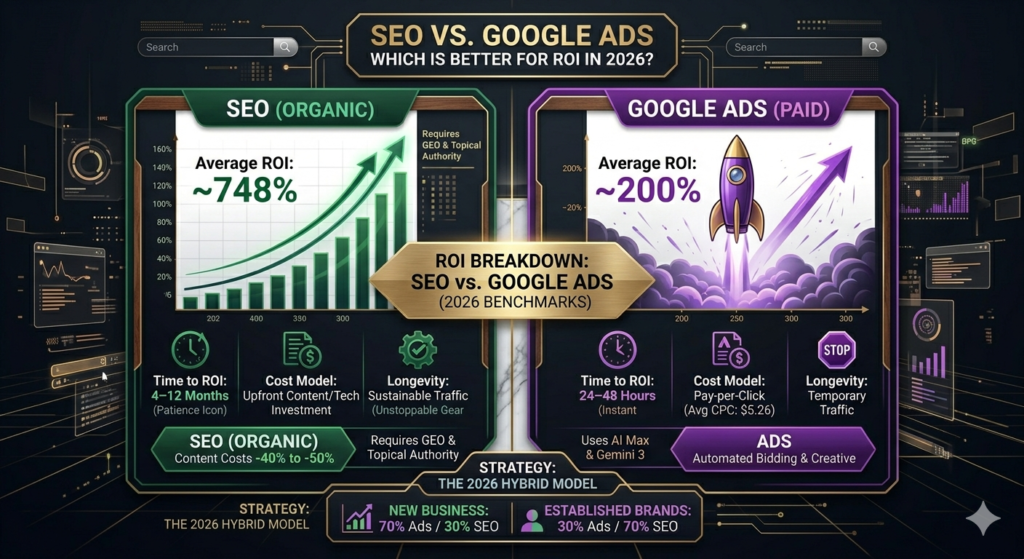
1. Introduction — The Real Marketing War in 2026
Digital marketing in 2026 is no longer about simply “getting traffic.” It is about survival in a hyper-competitive attention economy.
Businesses in the United States, UK, Canada, and Australia are spending billions every year on visibility. But the real debate remains the same:
👉 Should you invest in SEO or Google Ads?
This question is not simple because both systems operate differently:
- SEO builds long-term authority
- Google Ads provides instant visibility
- SEO reduces cost over time
- Ads require continuous spending
But the real truth is deeper:
The winning businesses in 2026 are not choosing one—they are strategically combining both.
Today’s user journey is complex:
- A user searches on Google
- Watches YouTube reviews
- Checks social media
- Returns via ads
- Finally converts after trust is built
This means your marketing strategy must cover multiple touchpoints, not just one channel.
2. What is SEO? (Deep Breakdown)
Search Engine Optimization (SEO) is the process of improving your website so it appears organically in search results on platforms like Google.
But in 2026, SEO is no longer just “keywords and backlinks.”
It is now built on 3 powerful pillars:
🔵 1. Content Authority
- High-quality blogs
- Expert-level information
- Deep topic coverage
🔵 2. Technical SEO
- Page speed optimization
- Mobile-first indexing
- Structured data
🔵 3. User Experience (UX)
- Engagement time
- Bounce rate reduction
- Navigation clarity
📌 Why SEO matters more today:
- It builds trust automatically
- It generates free long-term traffic
- It improves brand credibility
- It reduces dependency on ads
📊 SEO benefits summary:
- No cost per click
- Sustainable traffic
- High trust factor
- Compound growth effect
3. What is Google Ads? (Deep Breakdown)
Google Ads is a paid system where businesses bid for visibility.
In simple terms:
👉 You pay to appear at the top instantly.
But in 2026, Google Ads is no longer manual—it is powered by AI systems that optimize:
- Targeting
- Bidding
- Ad placement
- Audience segmentation
📌 Google Ads works like this:
- You choose keywords
- Set a budget
- Create ads
- Compete in real-time auctions
📊 Key advantages:
- Instant traffic
- Predictable scaling
- Highly targeted users
- Easy testing
⚠️ But also limitations:
- Cost increases with competition
- Traffic stops when budget stops
- Requires constant optimization
- Can become expensive in high-CPC industries
4. Evolution of SEO vs Ads (2010 → 2026 Deep Insight)
To understand today’s debate, we must understand history.
🕰️ Early SEO (2010–2015)
- Keyword stuffing worked
- Backlinks were easy
- Rankings were fast
🕰️ Mid SEO (2016–2020)
- Google introduced AI ranking
- Content quality became important
- Mobile-first indexing started
🧠 Modern SEO (2021–2026)
- EEAT became core ranking factor
- AI search systems evolved
- User intent became dominant
📈 Ads evolution:
- Manual bidding → AI bidding
- Simple text ads → smart responsive ads
- Basic targeting → predictive targeting
🚀 Key takeaway:
Both SEO and Ads are now AI-driven ecosystems, not manual systems.
5. Core Differences Between SEO and Google Ads
This is where most businesses misunderstand strategy.
🔵 SEO = Asset Building
SEO is like:
- Buying a house
- Building equity
- Long-term investment
Benefits:
- Free traffic over time
- Brand authority
- High trust ranking
🔴 Google Ads = Renting Traffic
Ads are like:
- Renting a house
- Paying monthly
- Immediate access
Benefits:
- Instant leads
- Fast testing
- Controlled spending
📊 Direct Comparison:
| Factor | SEO | Google Ads |
|---|---|---|
| Speed | Slow | Instant |
| Cost | Low long-term | High ongoing |
| Trust | High | Medium |
| Sustainability | Strong | Weak |
| Scalability | Organic growth | Budget dependent |
6. How SEO Works in 2026 (Deep System Breakdown)
SEO in 2026 is no longer a simple ranking game. It is a full ecosystem of trust, authority, and user satisfaction signals.
Search engines like Google now use advanced AI systems to evaluate whether content is actually helpful or just optimized for keywords.
To rank today, SEO works through three interconnected systems:
🔵 1. Intent Matching System
Search engines analyze what the user actually means, not just what they type.
For example:
- “best marketing strategy” → informational intent
- “hire SEO agency USA” → transactional intent
Key SEO actions:
- Write content that answers real questions
- Avoid keyword stuffing
- Focus on user problems
🔵 2. Authority Evaluation System (EEAT)
Google now evaluates:
- Experience
- Expertise
- Authoritativeness
- Trustworthiness
What improves authority:
- Expert-written content
- Case studies
- Real-world examples
- Consistent publishing
🔵 3. Engagement Signal System
Google tracks how users behave:
- Do they stay on your page?
- Do they scroll?
- Do they click internal links?
SEO goal:
Make content so useful that users don’t leave quickly.
📌 SEO in 2026 summary:
- Focus on intent
- Build authority
- Improve engagement
- Provide real value
7. How Google Ads Works in 2026 (AI-Powered System)
Google Ads has evolved into a fully AI-optimized bidding ecosystem.
With Google Ads, advertisers no longer manually control everything.
Instead, AI manages:
🔴 1. Smart Bidding System
AI automatically adjusts bids based on:
- User behavior
- Device type
- Location
- Time of search
Example:
A high-intent user in New York searching “buy software now” gets higher bidding priority than a casual browser.
🔴 2. Audience Prediction Engine
Google Ads predicts:
- Who is likely to buy
- Who will ignore ads
- Who will convert later
This improves targeting accuracy significantly.
🔴 3. Ad Creative Optimization
AI tests multiple versions of ads:
- Headlines
- Descriptions
- CTAs
Then automatically pushes the best-performing version.
📌 Google Ads summary:
- Instant visibility
- AI automation
- Performance-based pricing
- High competition environment
8. SEO Cost vs Google Ads Cost (Deep Financial Breakdown)
Understanding cost is critical for ROI decisions.
🔵 SEO Costs (2026 USA Market)
SEO is an investment model.
Typical breakdown:
- Content creation: $100–$2000 per article
- SEO tools: $100–$500/month
- Agency fees: $2000–$10,000/month
Key insight:
SEO cost decreases over time while results increase.
🔴 Google Ads Costs (2026 Market)
Ads are a continuous spending model.
Typical breakdown:
- CPC (cost per click): $1–$50+
- Monthly budget: $1000–$100,000+
- Management fees: 10–20% of spend
⚠️ Important reality:
- SEO = you build asset value
- Ads = you pay for temporary visibility
9. ROI Comparison (Real Business Logic)
ROI is where the real decision happens.
🔵 SEO ROI Model
SEO follows a compounding return curve:
Phase 1:
- Low traffic
- High effort
Phase 2:
- Traffic starts increasing
- Cost per lead decreases
Phase 3:
- Passive traffic flow
- High ROI stability
🔴 Google Ads ROI Model
Ads follow a linear spending model:
Pattern:
- Spend more → get more traffic
- Stop spending → traffic stops
📊 Key insight:
SEO = exponential ROI
Ads = linear ROI
10. Short-Term vs Long-Term Strategy
🔵 SEO (Long-Term Strategy)
SEO is ideal for:
- Brand building
- Organic traffic growth
- Authority positioning
Benefits:
- Sustainable traffic
- Lower long-term cost
- Strong trust factor
🔴 Google Ads (Short-Term Strategy)
Ads are ideal for:
- Product launches
- Promotions
- Immediate lead generation
Benefits:
- Instant visibility
- Predictable traffic
- Fast testing
📌 Smart business insight:
👉 SEO builds foundation
👉 Ads accelerate growth
11. Traffic Quality Comparison
Not all traffic is equal.
🔵 SEO Traffic Quality
SEO traffic is:
- Highly trusted
- Informational + intent-based
- Longer session duration
Users trust organic results more because they appear naturally.
🔴 Ads Traffic Quality
Ads traffic is:
- High-intent but paid
- More conversion-focused
- Sometimes lower trust
📊 Key takeaway:
SEO builds trust traffic
Ads capture intent traffic
12. Conversion Behavior Differences
🔵 SEO Conversions
- Slower conversion cycle
- Multiple touchpoints
- Higher long-term loyalty
🔴 Ads Conversions
- Faster decisions
- Direct response behavior
- Immediate purchases
13. Trust Factor in SEO vs Ads
Trust is one of the biggest ranking and conversion factors in 2026.
🔵 SEO Trust
- Organic ranking feels natural
- Users trust top results
- Builds brand authority
🔴 Ads Trust
- Clearly labeled as ads
- Some users skip them
- Works best for urgent needs
14. When SEO is the Better Choice
Choose SEO if:
- You want long-term growth
- You are building a brand
- You want passive traffic
- You can invest time
15. When Google Ads is the Better Choice
Choose Ads if:
- You need fast results
- You are launching a product
- You want instant leads
- You have budget flexibility
16. Hybrid Strategy (Best 2026 Approach)
The most successful businesses combine both:
Strategy:
- SEO builds foundation
- Ads generate immediate revenue
- Data from Ads improves SEO strategy
17. Final Insight of This Section
There is no “winner” between SEO and Google Ads.
Instead, there is a smart combination strategy:
👉 SEO = long-term asset
👉 Ads = short-term accelerator
Businesses that understand this win consistently in 2026.
18. AI Impact on SEO and Google Ads in 2026
Artificial intelligence has completely changed how digital marketing works in 2026. Both SEO and Google Ads are now heavily dependent on AI systems rather than manual optimization.
Search engines like Google and ad platforms like Google Ads use machine learning to analyze billions of data points in real time.
AI is no longer just a tool — it is the decision-making engine behind digital marketing performance.
🔵 AI in SEO (How it works)
AI in SEO focuses on understanding:
- User intent behind searches
- Content quality and depth
- Authority signals (EEAT)
- Behavioral engagement metrics
📌 What this means in practice:
- Google can detect “thin content” even if keywords are correct
- AI prioritizes content that solves real problems
- Search rankings change dynamically based on user behavior
💡 Key SEO impact:
- Keyword stuffing is useless
- Content depth is more important than ever
- Expertise signals matter more than backlinks alone
🔴 AI in Google Ads (How it works)
AI in Google Ads is more performance-driven and conversion-focused.
It controls:
- Smart bidding strategies
- Audience targeting
- Ad placement optimization
- Budget allocation
📌 What this means:
- Advertisers no longer manually optimize campaigns
- AI decides where and when ads perform best
- Conversion prediction is automated
💡 Key Ads impact:
- Higher efficiency
- Less manual control
- More dependence on data quality
19. SEO vs Google Ads ROI Comparison Table (2026)
Here is a clear ROI breakdown table:
| Factor | SEO | Google Ads |
|---|---|---|
| Initial Cost | Medium–High | Medium–High |
| Ongoing Cost | Low | High |
| ROI Speed | Slow (3–6 months) | Instant |
| ROI Stability | Very High | Low–Medium |
| Scalability | Organic growth | Budget dependent |
| Trust Factor | High | Medium |
| Long-term Profit | Very High | Moderate |
| Risk Level | Low–Medium | Medium–High |
📌 Key insight:
SEO wins in long-term profitability, while Google Ads wins in short-term performance speed.
20. Industry-Wise ROI Breakdown (Very Important)
Different industries perform differently with SEO and Ads.
🟢 SaaS Industry
| Strategy | Performance |
|---|---|
| SEO | Very High ROI |
| Ads | High but expensive |
- SEO builds authority for long-term subscriptions
- Ads are used for lead generation
🟡 E-commerce
| Strategy | Performance |
|---|---|
| SEO | Medium–High |
| Ads | Very High |
- Ads drive immediate sales
- SEO supports organic product discovery
🔵 Local Businesses
| Strategy | Performance |
|---|---|
| SEO | Very High |
| Ads | Medium |
- Local SEO dominates long-term
- Ads useful for promotions
🔴 Finance / Legal
| Strategy | Performance |
|---|---|
| SEO | High (slow growth) |
| Ads | Very expensive but effective |
- High CPC makes Ads costly
- SEO builds trust over time
21. Budget Strategy Models for 2026
A smart marketing budget is essential for ROI.
💡 Model 1: Startup Strategy
- 60% Google Ads
- 40% SEO
Why:
Startups need fast traction and validation.
💡 Model 2: Growth Stage Strategy
- 50% SEO
- 50% Ads
Why:
Balance between growth and stability.
💡 Model 3: Mature Business Strategy
- 70% SEO
- 30% Ads
Why:
Focus on long-term organic dominance.
22. Conversion Optimization Deep Dive
Conversions depend on how well traffic is converted into action.
🔵 SEO Conversion Strategy
SEO requires:
- Strong content structure
- Educational landing pages
- Trust-building elements
Example:
A blog builds awareness → leads to email signup → conversion later.
🔴 Ads Conversion Strategy
Google Ads focuses on:
- Direct CTA landing pages
- Sales-driven messaging
- Fast decision triggers
Example:
Ad → product page → immediate purchase
23. Real-World Case Study: SEO Growth Example
A US-based SaaS company invested heavily in SEO:
Strategy:
- 6 months content creation
- High-authority backlinks
- Topic clusters
Result:
- Organic traffic increased by 320%
- Cost per lead dropped by 70%
- Long-term monthly leads stabilized
👉 This shows SEO builds compounding value over time
24. Real-World Case Study: Google Ads Growth Example
An e-commerce brand in the US used Google Ads:
Strategy:
- High-budget PPC campaigns
- AI automated bidding
- Product retargeting
Result:
- Immediate sales within 24 hours
- ROI fluctuated based on ad spend
- Strong short-term revenue spikes
👉 Ads provide fast but dependent growth
25. Common Mistakes Businesses Make
Many businesses fail because they misunderstand strategy.
SEO mistakes:
- Expecting fast results
- Ignoring content quality
- Not updating content
Ads mistakes:
- Not tracking ROI
- Overbidding keywords
- Poor landing pages
26. Hybrid Strategy (Winning Model in 2026)
The most successful businesses combine both strategies intelligently.
📌 Hybrid approach:
- SEO builds authority and organic traffic
- Ads generate immediate revenue
- Data from Ads improves SEO targeting
💡 Example workflow:
- Run Google Ads → find converting keywords
- Use SEO to rank for those keywords
- Reduce ad spend over time
- Scale organic traffic
27. Future of SEO vs Google Ads (2026–2030)
The future will be shaped by AI and automation.
Expected trends:
- AI search engines replacing traditional SERPs
- Voice and visual search dominance
- Fully automated ad campaigns
- SEO becoming more intent-based than keyword-based
📌 Final insight:
Marketing will shift from:
👉 “Ranking pages”
to
👉 “Solving user intent with AI-driven content”
28. Final Verdict
There is no absolute winner between SEO and Google Ads.
However:
- SEO = long-term digital asset
- Google Ads = short-term revenue engine
🏁 Best strategy in 2026:
👉 Use SEO for sustainable growth
👉 Use Google Ads for fast scaling
👉 Combine both for maximum ROI
Author
Hannah Smith
Digital Marketing Strategist
10+ years experience in SEO, PPC & content marketing
Specialized in US & global performance marketing systems

[…] Read More […]
[…] Read More […]