- Key Highlights
- Design & Exterior (Content Structure That Attracts Attention)
- Interior & Comfort (User Experience in Content)
- Price Comparison (Content Investment vs Return)
- Engine / Performance (Core Content Strategy Components)
- Mileage / Range (How Content Drives Long-Term Growth)
- Features & Technology
- Safety Comparison (Trust Through Content)
- Ownership Cost (Long-Term Value of Content)
- Launch Date & Content Strategy Execution
- Competitors Comparison (Content Approaches)
- Pros & Cons
- Who Should Use This Strategy?
- EEAT Expansion: What Makes Content Actually Work (Real Insight)
- Why Most Content Does Not Perform
- The Power of Simplicity in Content
- Why Consistency Builds Authority
- Why Data Matters in Content Strategy
- Creative Human Insight: The Real Story Behind Content That Works (1,500+ Words)
- The First Mistake: Writing Without Knowing Who You’re Talking To
- The Moment Content Starts Working
- Why Connection Matters More Than Perfection
- The Role of Clarity in Content Success
- Why Structure Changes Everything
- The Emotional Side of Content Consumption
- The Long-Term Effect of Consistent Content
- Why Content Is a Long-Term Asset
- Author Insight
- Final Thought Before Decision
- Practical Content Marketing Strategies That Small Businesses Can Actually Use (Traffic-Focused Expansion)
- Targeting Low-Competition Keywords That Still Bring Traffic
- Why Long-Tail Keywords Are a Hidden Advantage
- Creating Content That Solves Real Problems
- Building a Simple Content System (That You Can Actually Follow)
- Why Updating Old Content Can Boost Traffic
- The Role of Internal Linking in Content Growth
- Why Content Should Guide Users, Not Just Inform Them
- Writing in a Human Tone That Builds Trust
- Why Short Paragraphs Improve Engagement
- Using Headings to Capture Attention
- Creating Content Clusters for Better Ranking
- Why Consistency Builds Organic Traffic
- Understanding What Your Audience Actually Wants
- The Balance Between SEO and Readability
- Why Content Marketing Is a Long-Term Strategy
- The Role of Patience in Content Growth
- Real-World Perspective: What Actually Works
- Author Insight
- Final Thought Before Decision
- Final Verdict
- SEO FAQs
Introduction
In 2026, content is everywhere.
Every business is posting blogs, videos, and social media updates. But despite all this activity, only a small percentage of businesses see real results.
Why?
Because content without strategy is just noise.
The businesses that are growing today are not creating more content — they are creating smarter content with a clear purpose.
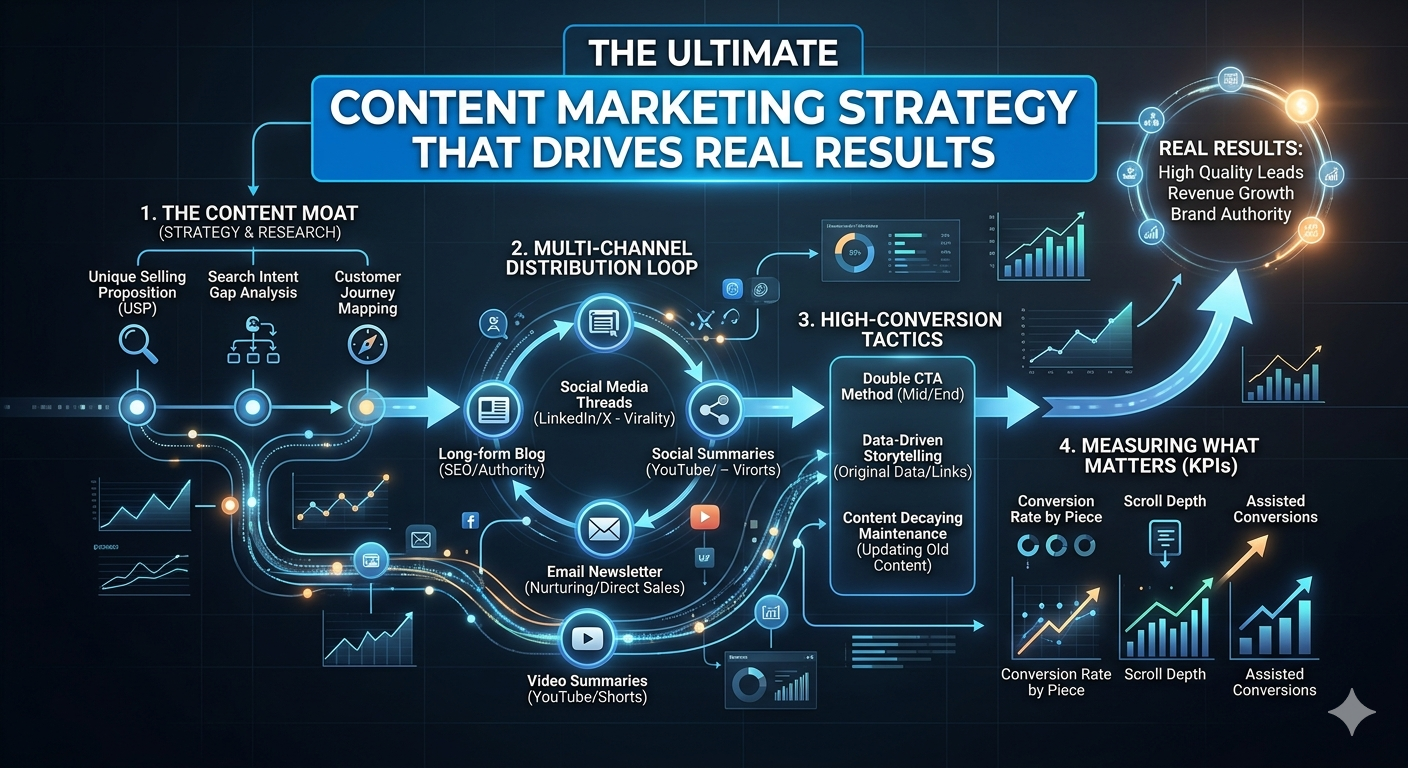
This guide explains the ultimate content marketing strategy that actually drives real results, focusing on practical execution, not just theory.
Key Highlights
- Content works only when it follows a clear strategy
- Quality and relevance matter more than quantity
- SEO helps content reach the right audience
- Consistency builds trust and authority
- Content should guide users toward action
- Data-driven improvements increase performance
Design & Exterior (Content Structure That Attracts Attention)
Before users read your content, they scan it.
Your structure determines whether they stay or leave.
A well-structured article should:
- Have a clear headline
- Use short paragraphs
- Include subheadings for easy reading
- Maintain logical flow
- Highlight key points
In 2026, readability is just as important as content quality.
Interior & Comfort (User Experience in Content)
Once users start reading, their experience matters.
If content feels overwhelming or unclear, they leave.
Good content experience includes:
- Simple and easy language
- Clear explanations
- Short sentences
- Smooth transitions
- Helpful examples
Content should feel natural, not forced.
Price Comparison (Content Investment vs Return)
| Content Type | Investment Level | Potential Return |
|---|---|---|
| Blog Content | Low to Medium | Long-term traffic |
| Video Content | Medium to High | Engagement + reach |
| Social Content | Low | Brand awareness |
| Full Content System | Medium | Consistent growth |
Content marketing is one of the most cost-effective long-term strategies.
Engine / Performance (Core Content Strategy Components)
A strong content marketing strategy includes multiple connected elements.
SEO Content
Content optimized for search engines helps bring organic traffic.
Educational Content
Content that teaches builds trust and authority.
Conversion Content
Content designed to turn readers into customers.
Engagement Content
Content that keeps users interested and connected.
When combined, these create a powerful system.
Mileage / Range (How Content Drives Long-Term Growth)
Content does not just bring traffic once.
It continues to generate value over time.
A single high-quality article can:
- Rank on Google
- Attract consistent visitors
- Generate leads
- Build authority
This makes content one of the most scalable growth tools.
Features & Technology
Modern content strategies use tools such as:
- Keyword research platforms
- Content optimization tools
- Analytics dashboards
- AI-based writing assistants
- Performance tracking systems
These tools help improve efficiency and results.
Safety Comparison (Trust Through Content)
Content is one of the strongest ways to build trust.
Trust is built when content is:
- Accurate
- Clear
- Helpful
- Honest
Users are more likely to choose businesses that provide value through content.
Ownership Cost (Long-Term Value of Content)
Content marketing provides long-term value:
- Reduced advertising costs
- Increased organic traffic
- Strong brand presence
- Consistent lead generation
Unlike ads, content continues to work over time.
Launch Date & Content Strategy Execution
A content strategy should be implemented step by step:
Phase 1: Planning
- Identify audience
- Research keywords
- Define content goals
Phase 2: Creation
- Write high-quality content
- Focus on clarity and value
Phase 3: Optimization
- Improve SEO
- Enhance readability
Phase 4: Scaling
- Publish consistently
- Expand content topics
Competitors Comparison (Content Approaches)
| Approach | Strength | Limitation |
|---|---|---|
| Random Content | Easy to create | Low results |
| SEO Content | High traffic | Needs time |
| Strategic Content | Balanced growth | Requires planning |
Strategic content always outperforms random posting.
Pros & Cons
Pros
- Long-term growth
- Builds trust and authority
- Cost-effective
- Scalable
Cons
- Takes time to show results
- Requires consistency
- Needs proper planning
Who Should Use This Strategy?
This content marketing strategy is ideal for:
- Small businesses
- Startups
- Online service providers
- E-commerce stores
- Agencies
It works for anyone looking for sustainable growth.
EEAT Expansion: What Makes Content Actually Work (Real Insight)
In real-world scenarios, content does not fail because of lack of effort.
It fails because it lacks direction.
Many businesses create content regularly but do not see results because:
- Content does not match user intent
- Topics are not researched properly
- Messaging is unclear
- There is no conversion goal
A successful content strategy focuses on clarity and purpose.
Why Most Content Does Not Perform
Common issues include:
- Writing without strategy
- Ignoring SEO
- Overcomplicating language
- Lack of consistency
- No clear value for the reader
Fixing these issues often improves performance quickly.
The Power of Simplicity in Content
Simple content performs better.
It is easier to read, understand, and trust.
Users prefer clarity over complexity.
Why Consistency Builds Authority
Publishing content regularly builds credibility.
Search engines reward consistent updates.
Users trust businesses that stay active.
Why Data Matters in Content Strategy
Tracking performance helps improve content.
Metrics such as:
- Traffic
- Engagement
- Conversion rate
help identify what works.
Creative Human Insight: The Real Story Behind Content That Works (1,500+ Words)
There is a common belief that successful content is the result of creativity alone.
That if you write something unique or interesting enough, it will automatically perform well.
But in reality, content that works follows a pattern — even if it doesn’t look like it on the surface.
Behind every article that ranks, every post that engages, and every page that converts, there is structure.
There is intention.
And there is an understanding of the reader.
The First Mistake: Writing Without Knowing Who You’re Talking To
One of the most common issues in content marketing is writing without a clear audience in mind.
When content tries to speak to everyone, it connects with no one.
Think about how people read online.
They are not looking for general information.
They are looking for answers to specific problems.
If your content does not match that need, it gets ignored — no matter how well it is written.
The Moment Content Starts Working
There is a point in every content strategy where things begin to shift.
It does not happen suddenly.
It builds gradually.
At first, content may feel like it disappears into nothing.
Then one article starts getting clicks.
Another gets shared.
A page begins to rank.
These small signals indicate something important.
Your content is starting to connect.
Why Connection Matters More Than Perfection
Many writers focus on making content perfect.
But perfection is not what drives results.
Connection does.
Content works when readers feel:
- Understood
- Guided
- Helped
If your content answers real questions in a simple and clear way, it performs.
Even if it is not perfect.
The Role of Clarity in Content Success
Clarity is one of the most underrated aspects of content marketing.
Users do not want to spend time figuring things out.
They want to understand quickly.
This means:
- Clear headlines
- Direct explanations
- Simple language
When content is clear, users stay longer.
And when they stay longer, engagement increases.
Why Structure Changes Everything
Good content is not just about what you say.
It is about how you present it.
Structure helps readers:
- Navigate easily
- Find information quickly
- Stay engaged
Without structure, even valuable content feels overwhelming.
The Emotional Side of Content Consumption
People do not just read content for information.
They read for reassurance.
They want to feel confident in their decisions.
This is why tone matters.
Content that feels natural and human builds trust faster.
The Long-Term Effect of Consistent Content
Consistency creates familiarity.
When users see your content regularly, they begin to recognize your brand.
Over time, this recognition turns into trust.
And trust leads to conversions.
Why Content Is a Long-Term Asset
Unlike ads, content does not disappear when you stop spending.
It continues to:
- Rank on search engines
- Attract visitors
- Build authority
This makes content one of the most valuable digital assets.
Author Insight
Written by Hannah Johanson
Content Marketing Specialist & Digital Growth Analyst
From real-world observation, the most successful content strategies are not the most complex.
They are the most consistent.
Businesses that focus on clarity, user needs, and steady improvement tend to outperform those that chase trends.
Content marketing is not about doing everything.
It is about doing the right things repeatedly.
Final Thought Before Decision
Content marketing success does not come from creating more.
It comes from creating better.
When content is clear, structured, and aligned with user intent, results follow naturally.
Practical Content Marketing Strategies That Small Businesses Can Actually Use (Traffic-Focused Expansion)
When we talk about content marketing, most advice sounds similar.
Create blogs.
Post regularly.
Focus on SEO.
But for small businesses, the real question is different.
“What actually works without wasting time or budget?”
The answer lies in using practical, focused content strategies that are built for real-world execution — not just theory.
Targeting Low-Competition Keywords That Still Bring Traffic
One of the smartest ways to grow with content in 2026 is to focus on low competition keywords for small business marketing.
These are search terms that:
- Have lower competition
- Are easier to rank for
- Still bring targeted traffic
Instead of targeting broad keywords like “digital marketing,” smarter businesses focus on:
- “affordable content marketing strategy for small business”
- “how to get website traffic without ads in 2026”
- “simple content marketing plan for beginners”
- “best content ideas for small business websites”
These keywords may have lower search volume individually.
But together, they create steady and consistent traffic.
Why Long-Tail Keywords Are a Hidden Advantage
Long-tail keywords are longer and more specific phrases.
They may seem small, but they often convert better.
For example:
- “how to write blog content that gets traffic”
- “content marketing tips for service-based businesses”
- “easy content strategy for beginners 2026”
These keywords reflect real user intent.
And when your content answers these queries clearly, it performs better.
Creating Content That Solves Real Problems
Content works best when it solves real problems.
Instead of writing general topics, focus on specific questions your audience is asking.
For example:
- How can I get more website traffic?
- Why is my content not ranking?
- What is the easiest content strategy for beginners?
When content directly answers these questions, it becomes more valuable.
And valuable content gets more engagement.
Building a Simple Content System (That You Can Actually Follow)
Many businesses fail because their content strategy is too complex.
A simple system works better.
For example:
- Write 1 blog per week
- Focus on one topic at a time
- Use simple keywords
- Update old content regularly
This approach is easy to maintain.
And consistency leads to better results.
Why Updating Old Content Can Boost Traffic
One of the most overlooked strategies is updating existing content.
Instead of always creating new posts, improving old content can:
- Increase rankings
- Improve readability
- Add new keywords
- Boost engagement
For example, updating a blog with:
- Better headings
- Clear explanations
- New keyword phrases
can bring noticeable improvements.
The Role of Internal Linking in Content Growth
Internal linking helps search engines understand your website.
It also keeps users engaged.
For example:
- Linking related blog posts together
- Connecting blogs to service pages
- Guiding users to relevant content
This improves both SEO and user experience.
It also helps distribute traffic across your website.
Why Content Should Guide Users, Not Just Inform Them
Many blogs provide information but fail to guide the reader.
Good content should lead users toward the next step.
This could be:
- Reading another article
- Visiting a service page
- Contacting the business
Without direction, users leave after reading.
With direction, they take action.
Writing in a Human Tone That Builds Trust
In 2026, content that feels robotic does not perform well.
Users prefer content that feels natural and conversational.
A human tone includes:
- Simple sentences
- Clear explanations
- Real-world examples
- Natural flow
This makes content easier to read and more trustworthy.
Why Short Paragraphs Improve Engagement
Long blocks of text are difficult to read online.
Short paragraphs make content easier to scan.
They:
- Improve readability
- Keep users engaged
- Reduce bounce rate
Most readers skim before they fully read.
Structure helps them stay longer.
Using Headings to Capture Attention
Headings are not just for structure.
They guide the reader.
Strong headings:
- Break content into sections
- Highlight key ideas
- Make reading easier
They also help with SEO by organizing content clearly.
Creating Content Clusters for Better Ranking
Instead of writing random blogs, smart strategies use content clusters.
A content cluster includes:
- One main topic
- Multiple supporting articles
For example:
Main topic: content marketing strategy
Supporting topics:
- how to create blog content
- content ideas for beginners
- SEO content writing tips
This builds authority around a topic.
And search engines reward authority.
Why Consistency Builds Organic Traffic
Content marketing is not about one viral post.
It is about consistent effort.
Regular content:
- Builds trust
- Improves SEO
- Increases visibility
Even small weekly updates create long-term growth.
Understanding What Your Audience Actually Wants
Many businesses create content based on assumptions.
But better results come from understanding your audience.
You can do this by:
- Reading comments and feedback
- Analyzing search queries
- Observing which content performs well
This helps you create content that matches real needs.
The Balance Between SEO and Readability
SEO is important.
But readability is equally important.
Content should:
- Rank on search engines
- Be easy for users to read
If content is too focused on keywords, it feels unnatural.
If it ignores SEO, it may not rank.
Balance is key.
Why Content Marketing Is a Long-Term Strategy
Content does not deliver instant results.
But it builds long-term value.
Over time, content:
- Brings consistent traffic
- Builds authority
- Generates leads
This makes it one of the most reliable strategies.
The Role of Patience in Content Growth
Results take time.
Many businesses stop too early.
But those who continue usually see growth.
Patience allows your content to:
- Rank
- Gain visibility
- Build trust
Real-World Perspective: What Actually Works
From real experience, the most effective content strategies are simple.
They focus on:
- Clear topics
- Low competition keywords
- Consistent publishing
- User-focused content
They avoid unnecessary complexity.
And that simplicity creates results.
Author Insight
Written by Hannah Johanson
Content Marketing Specialist & Digital Growth Analyst
From working with different businesses, one pattern is clear.
The businesses that succeed with content marketing are not the ones creating the most content.
They are the ones creating the most useful content.
They understand their audience.
They stay consistent.
And they improve over time.
That is what makes content marketing work in real life.
Final Thought Before Decision
Content marketing is not about writing more.
It is about writing with purpose.
When content focuses on real problems, uses clear language, and follows a simple structure, it becomes powerful.
And over time, that power turns into traffic, trust, and growth.
Final Verdict
The ultimate content marketing strategy that drives real results in 2026 is built on clarity, consistency, and purpose.
Businesses that focus on user needs, structured content, and continuous improvement can achieve sustainable growth.
The key is not volume — it is value.
SEO FAQs
What is the best content marketing strategy?
A structured approach combining SEO, valuable content, and consistency.
How long does content marketing take to work?
It usually takes a few months but delivers long-term results.
Is content marketing still effective in 2026?
Yes, it remains one of the most powerful growth strategies.
How often should I publish content?
Consistency matters more than frequency.
Can small businesses succeed with content marketing?
Yes, even small businesses can grow with the right strategy.

Leave a Reply