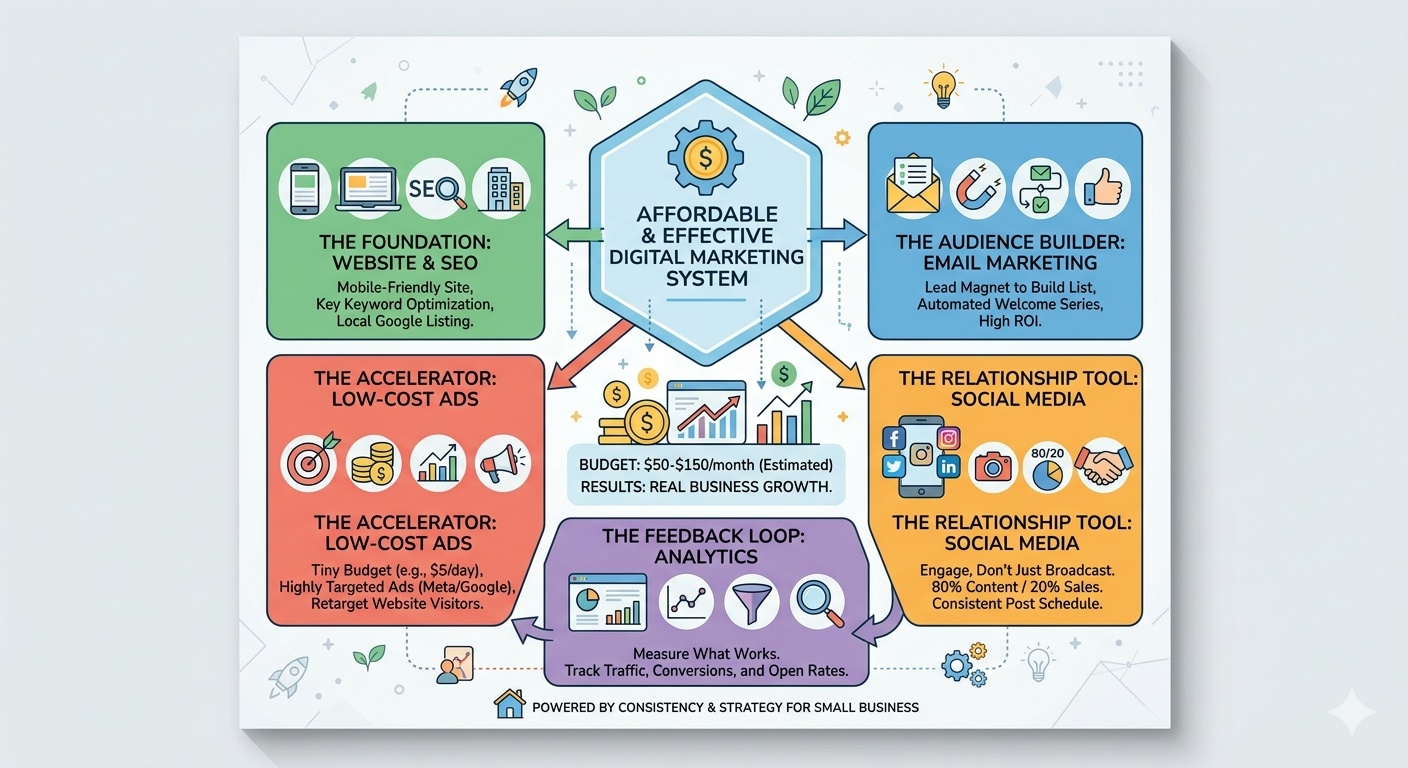
- Key Highlights
- Design & Exterior (Your Website as a Business Foundation)
- Interior & Comfort (User Experience That Builds Trust)
- Price Comparison (Affordable Marketing Investment for Small Businesses)
- Engine / Performance (Core Parts of the Digital System)
- Mileage / Range (How Small Businesses Scale Over Time)
- Features & Technology
- Safety Comparison (Building Trust in Small Business Marketing)
- Ownership Cost (Long-Term Value for Small Businesses)
- Launch Date & System Setup
- Competitors Comparison (Marketing Approaches for Small Businesses)
- Pros & Cons
- Who Should Use This System?
- EEAT Section: Real-World Understanding of Small Business Growth
- Why Systems Work Better Than Random Marketing
- Why Simplicity Is the Secret Advantage
- Final Thought Before Decision
- Final Verdict
- Why Small Businesses Struggle With Digital Marketing (Real Insight)
- The “One System” Mindset That Changes Everything
- Why Consistency Is More Valuable Than Budget
- The Role of Local SEO in Small Business Growth
- Why PPC Should Be Used Strategically, Not Aggressively
- Content as a Trust-Building Engine
- Why Data Tracking Separates Successful and Struggling Businesses
- The Importance of Customer Journey Mapping
- Why Overcomplication Reduces Growth
- Real-World Example of a Working System
- Why Patience Is Still Essential in 2026
- EEAT Insight: Why Experience Matters in Digital Strategy
- Final Thought Before Decision
- SEO FAQs
Introduction
In 2026, small businesses face a tough reality.
Competition online is stronger than ever, customer attention is limited, and advertising costs continue to rise.
But despite these challenges, one thing remains true — small businesses can still grow fast online without spending huge budgets.
The key is not “doing more marketing,” but building an affordable digital marketing system that actually works.
This guide explains how small businesses can create a simple, practical, and cost-effective digital system that drives real growth over time.
Key Highlights
- Small businesses can grow online without big budgets
- A system is more important than individual marketing tactics
- SEO builds long-term organic traffic
- PPC helps generate quick and targeted leads
- Content builds trust and authority
- Consistency matters more than spending
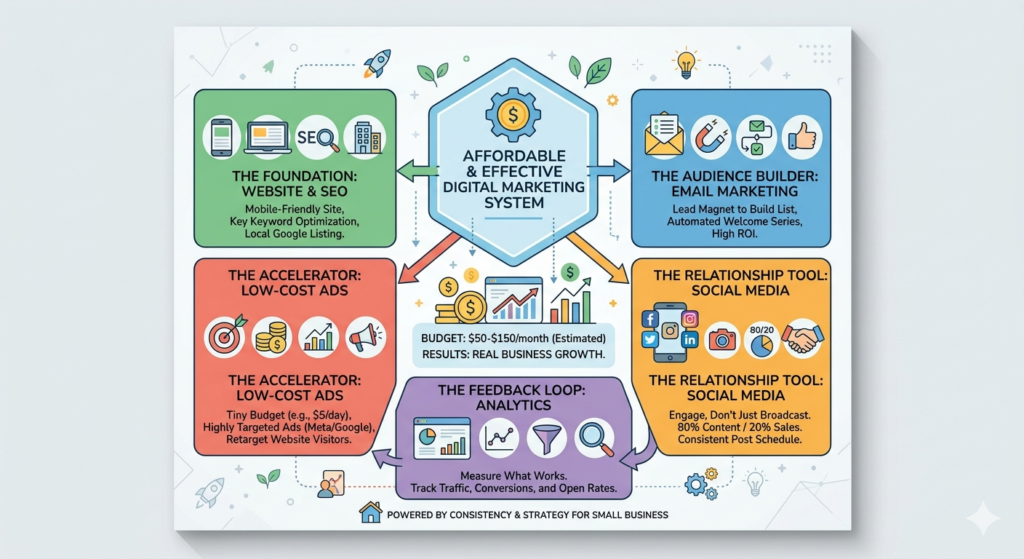
Design & Exterior (Your Website as a Business Foundation)
For small businesses, the website is not just a digital presence — it is the main sales tool.
Even if marketing is strong, a weak website can stop conversions instantly.
A strong small business website should be:
- Simple and easy to understand
- Mobile-friendly and fast
- Clear in services and pricing
- Focused on customer actions
- Designed for trust and clarity
In many real cases, improving website structure alone can increase leads without increasing ad spend.
That is why every digital system must start here.
Interior & Comfort (User Experience That Builds Trust)
Once a visitor lands on your website, their experience decides whether they stay or leave.
Small businesses often lose customers due to confusing layouts or unclear messaging.
A good user experience includes:
- Simple navigation menus
- Clear headings and structure
- Short and readable content
- Visible contact buttons
- Logical page flow
When users feel comfortable, they are more likely to take action — even without aggressive marketing.
Price Comparison (Affordable Marketing Investment for Small Businesses)
| Strategy Type | Monthly Cost Range |
|---|---|
| Basic SEO Setup | $300 – $1,000 |
| Local SEO | $250 – $800 |
| PPC Campaigns | $200 – $2,000 |
| Content Marketing | $200 – $1,500 |
| Full Digital System | $800 – $3,500 |
The goal is not to spend more, but to start small and scale based on results.
Engine / Performance (Core Parts of the Digital System)
An affordable digital marketing system is not a single tool — it is a combination of connected strategies.
SEO (Search Engine Optimization)
SEO helps small businesses appear in Google searches when customers are actively looking for services.
PPC (Paid Advertising)
PPC allows businesses to generate immediate traffic and test offers quickly.
Content Marketing
Content helps explain services, answer questions, and build trust.
Conversion Optimization
This ensures that website visitors actually become paying customers.
When all four elements work together, even a small business can compete with larger companies.
Mileage / Range (How Small Businesses Scale Over Time)
One of the biggest advantages of digital marketing is scalability.
Small businesses can grow step by step:
- Start with local customers
- Expand to nearby regions
- Scale nationally or online
- Build long-term brand presence
The system grows as results improve — not all at once.
This makes it ideal for businesses with limited budgets.
Features & Technology
Modern digital systems use smart tools that help small businesses save time and money.
These include:
- AI keyword research tools
- Analytics tracking platforms
- Automated ad optimization systems
- Content planning tools
- Customer behavior tracking
These tools help businesses make decisions based on data instead of guesswork.
Safety Comparison (Building Trust in Small Business Marketing)
For small businesses, trust is everything.
Even if traffic is high, customers will not convert without trust.
Trust is built through:
- Clear and honest communication
- Professional website design
- Transparent pricing or service details
- Consistent branding
In many cases, trust matters more than marketing budget.
Ownership Cost (Long-Term Value for Small Businesses)
An affordable digital system is not an expense — it is a long-term asset.
Over time, it helps small businesses:
- Reduce customer acquisition costs
- Increase organic traffic
- Build brand recognition
- Generate consistent leads
Unlike traditional advertising, digital systems continue working even after campaigns end.
Launch Date & System Setup
A small business digital system can be launched in phases:
Phase 1: Foundation Setup
- Website creation
- Basic SEO setup
- Service page optimization
Phase 2: Traffic Generation
- Local SEO targeting
- Small PPC campaigns
- Content publishing
Phase 3: Optimization
- Performance tracking
- Ad improvement
- Content refinement
Phase 4: Scaling
- Expanding keywords
- Increasing ad reach
- Improving conversion systems
Each phase builds on the previous one.
Competitors Comparison (Marketing Approaches for Small Businesses)
| Strategy | Strength | Limitation |
|---|---|---|
| SEO | Long-term growth | Takes time |
| PPC | Fast results | Requires monitoring |
| Social Media | Brand visibility | Inconsistent reach |
| Offline Marketing | Local reach | Hard to track ROI |
A complete system usually combines SEO and PPC for balance.
Pros & Cons
Pros
- Budget-friendly for small businesses
- Scalable over time
- Builds long-term visibility
- Generates consistent leads
- Works across industries
Cons
- Requires patience for SEO
- Needs consistent updates
- Results depend on execution quality
Who Should Use This System?
This affordable digital marketing system is ideal for:
- Small business owners
- Local service providers
- Startups with limited budgets
- Freelancers and consultants
- New online businesses
It works best for those who want steady and sustainable growth.
EEAT Section: Real-World Understanding of Small Business Growth
In real-world experience, small businesses often assume that success depends on large marketing budgets.
However, in practice, it is the structure of the system that matters more than the size of the investment.
A well-planned digital system allows even small businesses to compete effectively by focusing on:
- Clear targeting
- Simple messaging
- Consistent execution
- Data-driven improvements
Many successful small businesses do not start with big budgets. They start with clarity.
They understand their audience, create simple marketing systems, and improve gradually over time.
Why Systems Work Better Than Random Marketing
One of the biggest mistakes small businesses make is running disconnected marketing efforts.
For example:
- Running ads without SEO
- Posting content without strategy
- Building websites without optimization
This creates scattered results.
A system solves this by connecting everything together.
When all parts work in sync, results become more predictable and stable.
Why Simplicity Is the Secret Advantage
Small businesses often believe they need complex strategies to compete.
In reality, simplicity is more powerful.
Simple systems are:
- Easier to manage
- Easier to optimize
- Easier to scale
They also reduce confusion and save time, which is critical for small teams.
Final Thought Before Decision
An affordable digital marketing system is not about doing everything.
It is about doing the right things consistently with a clear structure.
Small businesses that focus on simplicity, consistency, and user experience are more likely to grow steadily in 2026.
Final Verdict
An affordable digital marketing system can deliver strong and sustainable results for small businesses in 2026 when built correctly.
By combining SEO, PPC, content, and conversion optimization into one structured system, even small businesses can achieve consistent growth without large budgets.
The key is not spending more — it is building smarter systems and improving them over time.
How Small Businesses Actually Make This Digital System Work in Real Life
In theory, every digital marketing system sounds effective.
SEO brings traffic, PPC brings quick leads, and content builds trust. But in real-world small business environments, execution is where everything changes.
Small businesses do not usually have large teams or unlimited budgets. That means every action must be intentional, simple, and measurable.
A successful affordable digital marketing system is not about doing more — it is about doing fewer things with greater focus.
Why Small Businesses Struggle With Digital Marketing (Real Insight)
Most small businesses fail in digital marketing not because the tools don’t work, but because the system is not structured properly.
Here are some common real-world challenges:
- No clear marketing direction
- Inconsistent posting or campaigns
- No tracking or measurement system
- Focus on trends instead of strategy
- Trying too many platforms at once
When these issues exist, even good marketing tools produce weak results.
The solution is not adding more tools — it is simplifying the system and making each part work together.
The “One System” Mindset That Changes Everything
Successful small businesses treat digital marketing as one connected system, not separate activities.
Instead of thinking:
- SEO is separate
- Ads are separate
- Website is separate
They think:
Everything is connected to one goal — generating customers.
This mindset changes how decisions are made.
For example:
- SEO content is written to support sales pages
- Ads are designed to match landing pages
- Website content supports trust-building
When everything is aligned, even small efforts produce stronger results.
Why Consistency Is More Valuable Than Budget
Many small businesses believe they need a large budget to compete.
But in reality, consistency plays a bigger role than spending.
For example:
- Posting content weekly builds authority
- Running small ads consistently improves data
- Updating SEO regularly improves rankings
Even with a small budget, consistent actions create momentum.
And momentum is what eventually leads to growth.
Without consistency, even high-budget campaigns fail to deliver stable results.
The Role of Local SEO in Small Business Growth
For many small businesses, local customers are the primary source of revenue.
This is where local SEO becomes extremely powerful.
Local SEO helps businesses appear in searches like:
- “near me” searches
- city-based service searches
- map listings
For example, a service business targeting a specific city can generate high-quality leads without competing globally.
This is one of the most cost-effective strategies available.
When combined with a strong Google Business Profile and consistent reviews, local SEO can outperform paid ads in the long run.
Why PPC Should Be Used Strategically, Not Aggressively
Paid advertising is often misunderstood.
Some businesses either avoid it completely or overspend without strategy.
In reality, PPC works best when used carefully.
A smart PPC approach includes:
- Small test budgets first
- Targeting high-intent keywords
- Tracking conversions properly
- Removing underperforming ads
This allows businesses to control costs while still generating leads.
The key is not how much you spend — but how precisely you target your audience.
Content as a Trust-Building Engine
Content is often underestimated in small business marketing.
But in reality, content plays a critical role in decision-making.
Before choosing a business, customers often:
- Read blogs
- Check service pages
- Look for answers to questions
- Compare options
If your content is clear, helpful, and easy to understand, it builds trust naturally.
And trust is what converts visitors into customers.
Good content does not need to be complicated.
It simply needs to answer real questions in a clear and honest way.
Why Data Tracking Separates Successful and Struggling Businesses
One of the biggest differences between growing businesses and stagnant ones is how they use data.
Small businesses often collect data but do not act on it.
A smart digital system uses data to improve continuously.
For example:
- If a page gets traffic but no conversions, improve the messaging
- If an ad performs well, increase focus on it
- If users leave quickly, improve page structure
This creates a feedback loop where every action improves the next one.
Over time, this leads to stronger performance without increasing cost.
The Importance of Customer Journey Mapping
Every customer follows a journey before making a decision.
Understanding this journey is one of the most powerful parts of digital marketing.
The journey usually includes:
Awareness Stage
The customer discovers a problem or need.
Research Stage
The customer searches for solutions and compares options.
Decision Stage
The customer chooses a provider.
A smart digital system creates content and marketing for each stage.
This ensures customers are guided naturally from discovery to purchase.
Why Overcomplication Reduces Growth
Many small businesses overcomplicate their digital strategy.
They try:
- Too many platforms
- Too many tools
- Too many campaigns
This creates confusion and reduces efficiency.
In most cases, simpler systems perform better because they are easier to manage and improve.
A focused approach often leads to:
- Better execution
- Clearer messaging
- Stronger results
Simplicity is not a limitation — it is an advantage.
Real-World Example of a Working System
A practical affordable digital marketing system for a small business might look like this:
- One optimized website
- One SEO content plan (weekly blogs)
- One local SEO strategy
- One small PPC campaign
- Monthly performance review
This system is simple, but effective.
Each part supports the others, creating a balanced growth structure.
Why Patience Is Still Essential in 2026
Even though digital tools are faster and more advanced today, results still take time.
SEO takes months to build authority.
Trust takes time to develop.
Brand recognition grows gradually.
Businesses that understand this are more likely to succeed because they stay consistent instead of giving up too early.
EEAT Insight: Why Experience Matters in Digital Strategy
Experience plays a major role in understanding what actually works.
Many strategies look good in theory but fail in execution.
Experienced marketers focus on:
- What converts, not just what trends
- What is simple, not what is complex
- What is sustainable, not what is temporary
This practical understanding is what makes a digital system effective in real business environments.
Final Thought Before Decision
An affordable digital marketing system is not about using every available tool.
It is about building a focused structure that connects all marketing efforts toward one goal — consistent business growth.
Small businesses that stay consistent, simplify their approach, and focus on real customer needs are more likely to succeed in the long term.
SEO FAQs
What is an affordable digital marketing system?
It is a structured combination of SEO, PPC, and content strategies designed for small business growth.
Can small businesses grow with digital marketing?
Yes, even small budgets can generate strong results with the right system.
What is the best strategy for small businesses?
A mix of SEO and PPC works best for steady and fast growth.
How long does it take to see results?
PPC is fast, while SEO usually takes a few months.
Do small businesses need a digital system?
Yes, systems create consistency and improve long-term results.

Leave a Reply