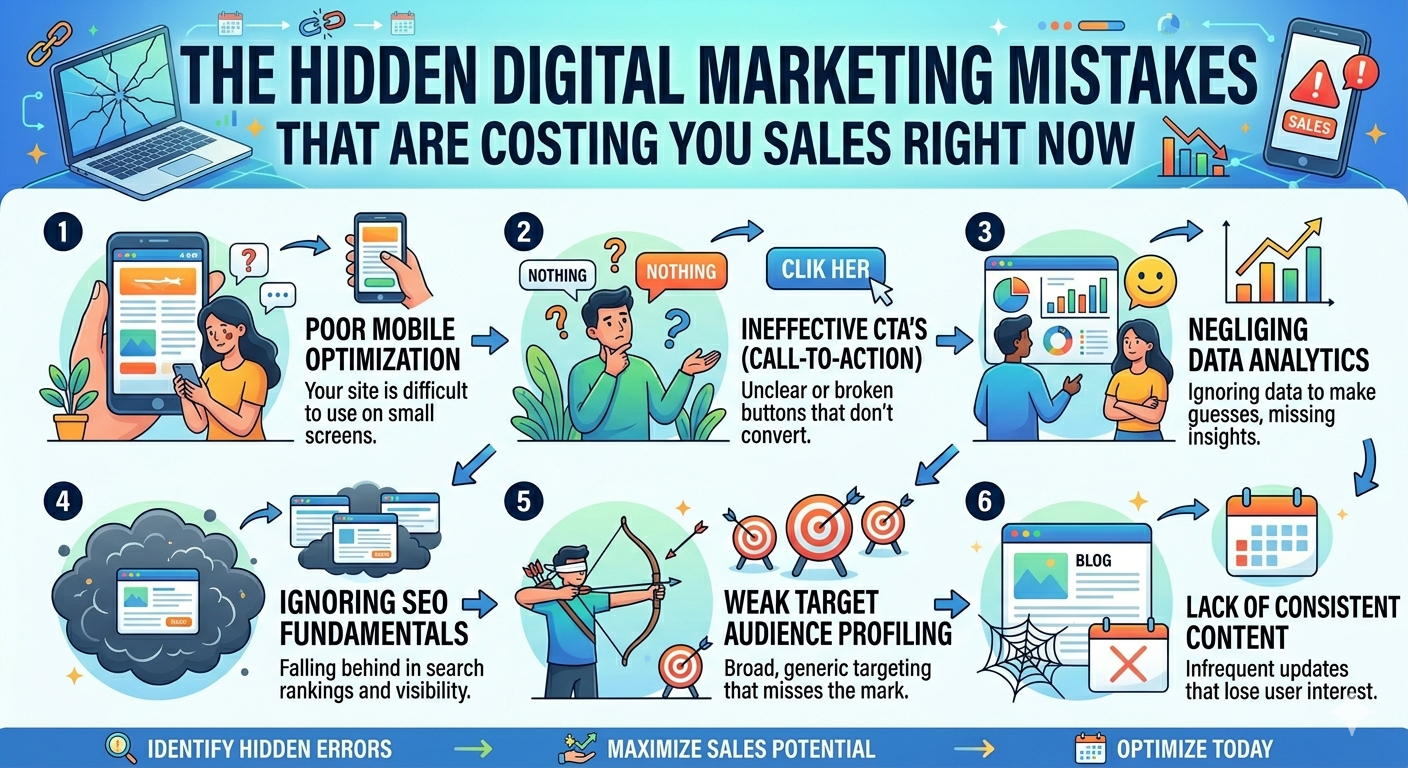
- Key Highlights
- Design & Exterior (Website Mistakes That Drive Customers Away)
- Interior & Comfort (User Experience Issues That Reduce Conversions)
- Price Comparison (Cost of Mistakes vs Optimized Strategy)
- Engine / Performance (Marketing Mistakes That Hurt Results)
- Mileage / Range (How Mistakes Limit Growth)
- Features & Technology
- Safety Comparison (Trust Issues That Reduce Sales)
- Ownership Cost (Long-Term Impact of Mistakes)
- Launch Date & Fixing Strategy
- Competitors Comparison (Mistake vs Optimized Approach)
- Pros & Cons
- Who Should Fix These Mistakes?
- EEAT Expansion: Real Reasons These Mistakes Keep Happening
- Real-World Fix: What Actually Works
- Final Thought Before Decision
- Behind the Scenes: What Really Happens When Digital Marketing Starts Failing (Human Insight)
- The Silent Gaps That Slowly Kill Conversions
- Why Visitors Don’t Think Like Business Owners
- The 5-Second Reality Check
- Why “Good Enough” Marketing Is Not Enough Anymore
- The Emotional Side of Buying Decisions
- The Power of Clear Messaging (A Simple Shift That Changes Everything)
- Why Small Improvements Often Bring Big Results
- The “Leaky Bucket” Problem in Digital Marketing
- Why More Traffic Is Not Always the Answer
- The Role of Patience in a Fast-Paced Digital World
- Why Consistency Builds Momentum
- Real Talk: What Actually Separates Growing Businesses
- The Shift From “Doing More” to “Doing Better”
- A Final Real-World Perspective
- Final Thought Before Decision
- Final Verdict
- SEO FAQs
Introduction
Many businesses believe they are doing everything right.
They have a website, they run ads, they post content — yet sales remain inconsistent or lower than expected.
This is one of the most common frustrations in 2026.
The problem is not effort. The problem is hidden mistakes.
Small issues in digital marketing can quietly reduce conversions, waste budget, and limit growth without being obvious.
This guide reveals the most common digital marketing mistakes that are costing businesses real sales — and more importantly, how to fix them.
Key Highlights
- Small mistakes can significantly reduce conversions
- Poor targeting wastes marketing budget
- Weak websites reduce customer trust
- SEO errors limit organic traffic
- Lack of tracking leads to poor decisions
- Fixing mistakes often improves results without increasing spending
Design & Exterior (Website Mistakes That Drive Customers Away)
Your website is where most conversions happen.
However, many businesses lose customers before they even begin.
Common website mistakes include:
- Slow loading speed
- Confusing layout
- Unclear messaging
- Lack of mobile optimization
- No clear call-to-action
When users land on a website and feel confused, they leave immediately.
Even strong marketing campaigns cannot fix a weak website.
Interior & Comfort (User Experience Issues That Reduce Conversions)
User experience directly affects how long visitors stay and whether they take action.
Some common UX mistakes include:
- Too much text without structure
- Difficult navigation
- Lack of clear information
- Poor readability
A good user experience should feel simple and natural.
When users can easily find what they need, they are more likely to convert.
Price Comparison (Cost of Mistakes vs Optimized Strategy)
| Scenario | Impact on Business |
|---|---|
| Poor SEO | Low organic traffic |
| Weak PPC targeting | Wasted ad spend |
| Bad UX design | High bounce rate |
| No tracking | Poor decision-making |
| Optimized strategy | Higher ROI and conversions |
Fixing mistakes often costs less than continuing ineffective strategies.
Engine / Performance (Marketing Mistakes That Hurt Results)
The core of digital marketing performance lies in strategy execution.
Here are the most critical mistakes:
SEO Mistakes
- Targeting wrong keywords
- Ignoring search intent
- Inconsistent content updates
PPC Mistakes
- Broad audience targeting
- No conversion tracking
- Poor ad messaging
Content Mistakes
- Writing for search engines, not users
- Lack of useful information
- No clear purpose
Conversion Mistakes
- Weak landing pages
- No clear offer
- Complicated forms
These issues reduce performance even when traffic is high.
Mileage / Range (How Mistakes Limit Growth)
Digital marketing allows businesses to scale, but mistakes limit that growth.
For example:
- Poor SEO reduces long-term traffic
- Weak ads reduce immediate leads
- Bad UX reduces conversion rates
Fixing these mistakes expands your reach and improves results without increasing budget.
Features & Technology
Modern tools can help identify and fix mistakes quickly.
These include:
- Analytics tools for tracking behavior
- Heatmaps for user interaction
- Keyword research tools
- Ad performance dashboards
Using these tools helps businesses understand what is working and what needs improvement.
Safety Comparison (Trust Issues That Reduce Sales)
Trust is one of the most overlooked factors in digital marketing.
Mistakes that reduce trust include:
- Unclear service information
- Poor website design
- Lack of reviews or testimonials
- Inconsistent branding
Even small trust issues can stop users from converting.
Ownership Cost (Long-Term Impact of Mistakes)
Ignoring digital marketing mistakes can lead to:
- Continuous budget waste
- Low conversion rates
- Weak brand reputation
- Missed growth opportunities
Fixing these issues creates long-term value and improves overall performance.
Launch Date & Fixing Strategy
Fixing digital marketing mistakes should follow a structured approach:
Step 1: Audit Current System
Identify weak areas in SEO, ads, and website.
Step 2: Prioritize High-Impact Fixes
Focus on issues affecting conversions first.
Step 3: Implement Improvements
Update website, refine ads, improve content.
Step 4: Track Performance
Measure changes and adjust strategy.
Competitors Comparison (Mistake vs Optimized Approach)
| Approach | Result |
|---|---|
| Ignoring mistakes | Slow or no growth |
| Fixing key issues | Improved performance |
| Optimized strategy | Scalable growth |
Businesses that fix mistakes early usually outperform competitors.
Pros & Cons
Pros of Fixing Mistakes
- Higher conversion rates
- Better use of budget
- Improved user experience
- Stronger brand trust
Cons
- Requires time and analysis
- Needs consistent updates
Who Should Fix These Mistakes?
This applies to:
- Small businesses
- Startups
- Service providers
- E-commerce stores
- Agencies
Any business running digital marketing can benefit from identifying and fixing mistakes.
EEAT Expansion: Real Reasons These Mistakes Keep Happening
In real-world scenarios, most digital marketing mistakes are not intentional.
They happen because businesses focus on activity instead of strategy.
For example:
- Running ads without understanding audience intent
- Publishing content without clear goals
- Building websites without conversion planning
This creates effort without results.
Lack of Clear Direction
Many businesses start digital marketing without a defined plan.
This leads to scattered actions and inconsistent results.
A clear strategy helps align all efforts toward one goal.
Overcomplication of Marketing Systems
Trying too many tools and platforms creates confusion.
Simple systems are easier to manage and optimize.
Ignoring Data and Feedback
Data provides valuable insights, but many businesses do not use it effectively.
Tracking performance helps improve decisions.
Inconsistent Execution
Stopping and starting marketing efforts reduces momentum.
Consistency is what builds long-term success.
Focusing on Traffic Instead of Conversions
Traffic alone does not generate sales.
The focus should always be on converting visitors into customers.
Real-World Fix: What Actually Works
A simple and effective system includes:
- One optimized website
- One clear SEO strategy
- One focused PPC campaign
- Regular content updates
- Continuous tracking and improvement
This structure eliminates most common mistakes.
Final Thought Before Decision
Digital marketing mistakes are often hidden, but their impact is real.
Fixing these mistakes does not require a large budget — only clarity, focus, and consistency.
Businesses that identify and correct these issues usually see immediate improvements in performance.
Behind the Scenes: What Really Happens When Digital Marketing Starts Failing (Human Insight)
Let’s step away from strategies and look at reality.
Imagine a small business owner who has done everything “right.”
They built a website.
They hired someone for SEO.
They even ran ads for a few weeks.
At first, there was excitement.
Visitors started coming in. A few inquiries showed up. It felt like things were finally moving.
But then something strange happened.
Traffic stayed… but sales didn’t grow.
Leads dropped. Ads became expensive. And slowly, frustration replaced excitement.
This situation is more common than most people admit.
And the truth is — it rarely happens because marketing “doesn’t work.”
It happens because small, unnoticed gaps quietly break the system.
The Silent Gaps That Slowly Kill Conversions
Digital marketing rarely fails in a dramatic way.
Instead, it fails quietly.
A button is slightly unclear.
A page takes two extra seconds to load.
A headline doesn’t fully explain the offer.
These small issues don’t seem important individually.
But together, they create friction.
And friction is the biggest enemy of conversions.
Users don’t complain when they leave.
They just leave.
Why Visitors Don’t Think Like Business Owners
One of the biggest misunderstandings in digital marketing is assuming that visitors think the same way as business owners.
They don’t.
A business owner sees effort, investment, and strategy.
A visitor sees:
- How fast the page loads
- How easy it is to understand
- How quickly they find what they need
- Whether they trust what they see
That’s it.
They don’t analyze your marketing — they react to it.
This is why simplicity always wins.
The 5-Second Reality Check
In most cases, you have less than five seconds to make an impression.
Within those few seconds, a visitor decides:
- Do I understand this website?
- Does this solve my problem?
- Can I trust this business?
If the answer is unclear, they leave.
This is not about design trends or complex features.
It is about clarity.
And clarity is one of the most powerful conversion tools.
Why “Good Enough” Marketing Is Not Enough Anymore
In earlier years, just having a website or running ads was enough.
In 2026, that is no longer the case.
Users have more choices. More information. More expectations.
They compare quickly.
If your website or marketing feels average, they move on instantly.
This is not because your business is bad — it is because attention spans are shorter and competition is stronger.
This is why refining your strategy matters more than expanding it.
The Emotional Side of Buying Decisions
Digital marketing is often seen as technical.
But at its core, it is emotional.
People do not just buy services.
They buy confidence.
They buy clarity.
They buy trust.
If your marketing feels confusing, users hesitate.
If it feels clear and helpful, they move forward.
Even pricing decisions are influenced by how confident a user feels.
This is why tone, structure, and messaging matter as much as strategy.
The Power of Clear Messaging (A Simple Shift That Changes Everything)
One of the easiest ways to improve results is to simplify your message.
Instead of saying:
“We provide advanced digital solutions for scalable growth”
Say:
“We help your business get more customers online”
Simple language connects faster.
It removes friction.
And it makes decisions easier for users.
Clarity always outperforms complexity.
Why Small Improvements Often Bring Big Results
Many businesses look for major changes when results are low.
But in reality, small improvements often have the biggest impact.
For example:
- Improving a headline can increase clicks
- Simplifying a form can increase leads
- Speeding up a page can reduce bounce rate
- Changing a call-to-action can improve conversions
These are not big changes.
But they directly affect user behavior.
And user behavior is what drives results.
The “Leaky Bucket” Problem in Digital Marketing
Think of your marketing system like a bucket.
Traffic is the water you pour in.
If the bucket has holes, water leaks out.
In digital marketing, those holes are:
- Poor user experience
- Weak messaging
- Slow loading pages
- Lack of trust signals
Many businesses focus on pouring more water (traffic) instead of fixing the leaks.
But fixing the leaks is what actually improves results.
Why More Traffic Is Not Always the Answer
It is tempting to think that more traffic will solve everything.
But if your system is not optimized, more traffic only increases waste.
For example:
- If 100 visitors don’t convert, 1,000 may not either
- If your message is unclear, more people will still leave
- If trust is low, traffic won’t fix it
This is why optimization comes before scaling.
Fix first. Then grow.
The Role of Patience in a Fast-Paced Digital World
We live in a fast world.
Quick results are expected everywhere.
But digital marketing still follows a natural process.
- SEO builds slowly
- Trust develops over time
- Brand recognition grows gradually
Businesses that expect instant results often quit too early.
Those who stay consistent usually see results build over time.
Patience is not a weakness in digital marketing — it is a strategy.
Why Consistency Builds Momentum
Consistency may feel slow at first.
But over time, it creates momentum.
For example:
- Weekly content builds authority
- Regular updates improve rankings
- Continuous ads improve targeting
Each action builds on the previous one.
And eventually, growth becomes easier and faster.
This is when businesses start to scale.
Real Talk: What Actually Separates Growing Businesses
After analyzing many digital strategies, one pattern becomes clear.
Growing businesses are not always the smartest or the biggest.
They are simply more consistent and more focused.
They:
- Keep their systems simple
- Improve step by step
- Pay attention to user behavior
- Fix problems instead of ignoring them
They do not chase every trend.
They refine what already works.
The Shift From “Doing More” to “Doing Better”
Many businesses believe growth comes from doing more:
- More ads
- More posts
- More platforms
But real growth often comes from doing better:
- Better messaging
- Better targeting
- Better user experience
- Better clarity
This shift changes everything.
Because better systems produce better results — even with less effort.
A Final Real-World Perspective
If your digital marketing is not performing as expected, it does not mean failure.
It usually means adjustment is needed.
Every system can improve.
Every strategy can be refined.
And most importantly, every mistake can be fixed.
The key is to look at your system honestly, simplify where needed, and focus on what truly matters — the user experience.
Final Thought Before Decision
Digital marketing success is not built on perfection.
It is built on awareness, adjustment, and consistency.
When businesses understand how small details influence big outcomes, they gain control over their results.
And once that happens, growth becomes predictable — not accidental.
Final Verdict
The hidden digital marketing mistakes that are costing you sales can be fixed with a structured and simple approach.
By improving SEO, PPC, content, and user experience, businesses can increase conversions without increasing costs.
The key is not doing more — it is doing things correctly.
SEO FAQs
What are the biggest digital marketing mistakes?
Poor SEO, weak targeting, bad UX, and lack of tracking are common mistakes.
Can fixing mistakes improve sales?
Yes, even small improvements can increase conversions significantly.
How do I identify marketing mistakes?
By analyzing website performance, ad data, and user behavior.
Is SEO still important in 2026?
Yes, it remains one of the most effective long-term strategies.
Do small businesses make these mistakes?
Yes, but they can fix them easily with the right approach.

Leave a Reply