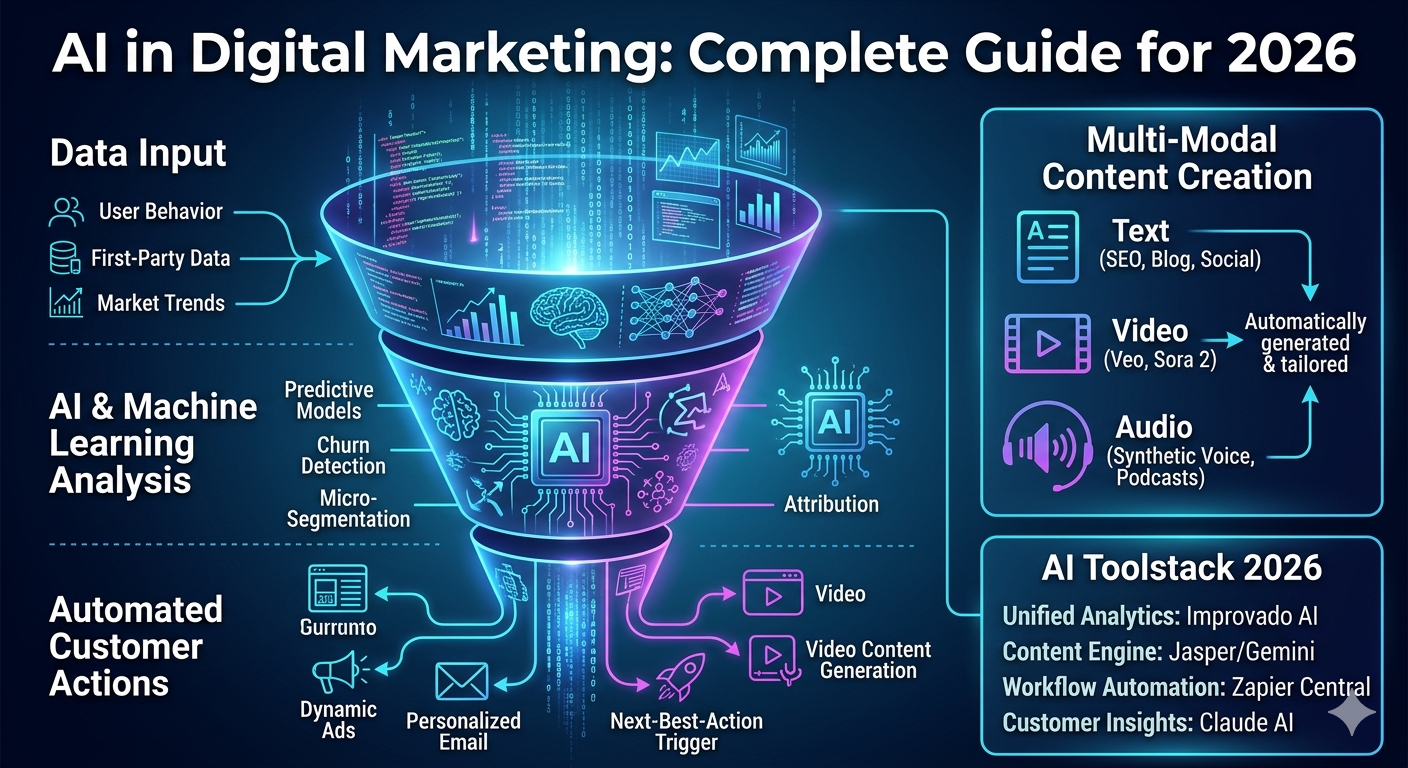
- 1. Introduction
- 2. What is AI in Digital Marketing?
- 3. Evolution of AI in Marketing
- 4. Why AI is Dominating in 2026
- 5. Core Benefits of AI
- 6. AI in Customer Behavior Analysis
- 7. AI in SEO (AEO & GEO)
- 8. AI in Content Marketing
- 9. AI in Paid Advertising
- 10. AI in Email Marketing
- 11. AI in Social Media Marketing
- 12. AI in Conversion Rate Optimization
- 13. AI Tools Marketers Use
- 14. Real-World Case Studies
- 15. Challenges & Risks
- 16. Future of AI in Marketing
- 17. Actionable Strategy for Businesses
- 18. AI and Voice Search Optimization in 2026
- 19. AI in Video Marketing and Content Creation
- 20. AI-Powered Chatbots and Customer Support
- 21. AI in Personal Branding and Influencer Marketing
- 22. AI in Local SEO and Geo-Targeting
- 23. AI and Data Privacy: What Marketers Must Know
- 26. AI in E-commerce Marketing
- 24. AI for Predictive Marketing Strategies
- 25. AI in Marketing Automation Funnels
- 26. AI and the Future of Search Engines
- 26. Final Verdict
Introduction
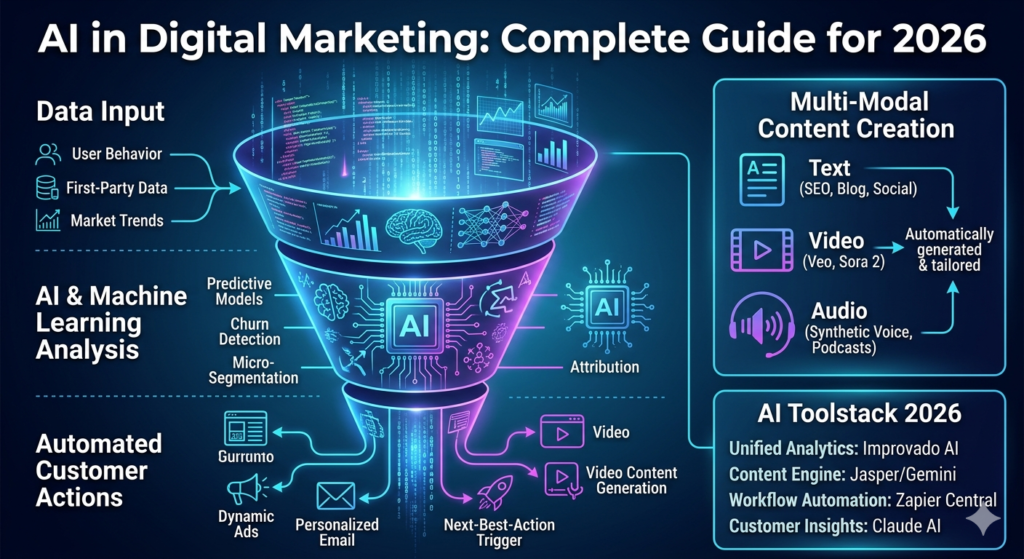
1. Introduction
Digital marketing in 2026 feels completely different from what it was just a few years ago. Businesses are no longer relying on guesswork, manual testing, or broad audience targeting. Instead, everything is becoming smarter, faster, and more precise—and that shift is being driven by artificial intelligence.
If you are running a business in the United States or any top-tier market, you’ve probably already noticed how competitive things have become. Customers expect personalized experiences, fast responses, and relevant content at every touchpoint. At the same time, marketing channels are becoming more complex, with search engines, social media platforms, and advertising networks constantly evolving.
This is exactly where AI steps in.
Rather than replacing marketers, AI is enhancing their ability to make better decisions, automate repetitive tasks, and understand customers at a deeper level. The brands that are winning in 2026 are not necessarily the biggest ones—they are the ones using AI intelligently.
2. What is AI in Digital Marketing?
Artificial Intelligence in digital marketing refers to systems that can analyze data, learn patterns, and make decisions with minimal human intervention. Unlike traditional tools, AI doesn’t just execute commands—it adapts based on performance and behavior.
In practical terms, AI helps marketers:
- Understand customer intent through data analysis
- Predict what users are likely to do next
- Automate campaigns across multiple channels
- Personalize content for each individual user
For example, when a user visits a website and sees product recommendations that feel “perfect,” that’s not random. It’s AI analyzing behavior in real time and delivering relevant suggestions.
This level of intelligence was simply not possible before.
3. Evolution of AI in Marketing
AI didn’t suddenly appear in 2026—it has been evolving for years.
In the early stages, digital marketing relied heavily on manual work:
- Keyword research was done manually
- Ads were optimized based on basic metrics
- Content was created without deep data insights
Then came automation tools, followed by machine learning systems that could process data more efficiently.
Now, in 2026, AI has reached a point where it can:
- Generate content
- Optimize campaigns in real time
- Predict customer journeys
- Deliver hyper-personalized experiences
This evolution has shifted marketing from reactive to proactive.
4. Why AI is Dominating in 2026
AI is not just a trend—it’s becoming the foundation of digital marketing.
There are several reasons behind this dominance:
- Data Explosion: Businesses now deal with massive amounts of data that humans cannot process manually
- Customer Expectations: Users expect personalized and instant experiences
- Increased Competition: Brands are competing globally, not locally
- Speed Requirement: Decisions need to be made in real time
AI solves all of these challenges by combining speed, accuracy, and scalability.
5. Core Benefits of AI
1. Hyper-Personalization
AI allows businesses to tailor experiences for each user individually.
This includes:
- Personalized emails
- Product recommendations
- Dynamic website content
Instead of treating all customers the same, AI ensures each interaction feels unique.
2. Better Decision Making
AI removes guesswork from marketing strategies.
Marketers can rely on:
- Predictive analytics
- Real-time insights
- Performance-based optimization
This leads to smarter investments and higher ROI.
3. Time Efficiency
Tasks that once required hours can now be completed in minutes.
AI automates:
- Campaign management
- Data analysis
- Reporting
- Audience segmentation
This allows marketers to focus on strategy rather than repetitive work.
4. Improved Customer Experience
AI enables faster and more relevant interactions.
For example:
- Chatbots provide instant responses
- AI-driven support systems solve problems quickly
- Personalized journeys improve engagement
6. AI in Customer Behavior Analysis
Understanding customer behavior is one of the most powerful applications of AI.
AI systems analyze:
- Browsing history
- Purchase patterns
- Engagement data
- Demographic information
This allows businesses to predict:
- What customers want
- When they are likely to buy
- Which products they prefer
Instead of reacting to customer actions, businesses can anticipate them.
7. AI in SEO (AEO & GEO)
Search engine optimization has changed dramatically with AI.
AEO (Answer Engine Optimization)
Content is now optimized to answer questions directly.
GEO (Generative Engine Optimization)
AI-driven search engines generate answers instead of listing links.
To succeed in SEO today, content must:
- Be clear and structured
- Provide direct answers
- Demonstrate expertise and authority
This is where EEAT becomes critical.
8. AI in Content Marketing
AI is transforming how content is created and distributed.
Marketers now use AI to:
- Generate blog ideas
- Optimize headlines
- Improve readability
- Analyze content performance
However, purely AI-generated content often lacks depth.
The content that ranks best combines:
- AI efficiency
- Human creativity
- Real-world insights
9. AI in Paid Advertising
AI has revolutionized paid advertising platforms like Google Ads and Meta Ads.
AI systems now handle:
- Audience targeting
- Bid adjustments
- Ad creative optimization
- Performance tracking
This leads to:
- Lower cost per click
- Higher conversion rates
- Better ROI
10. AI in Email Marketing
Email marketing has become more powerful with AI.
AI helps in:
- Personalizing email content
- Predicting best send times
- Segmenting audiences
- Improving open and click rates
Instead of sending mass emails, businesses now send highly targeted messages.
11. AI in Social Media Marketing
Social media platforms rely heavily on AI algorithms.
AI helps marketers:
- Identify trending content
- Optimize posting times
- Analyze audience engagement
- Automate responses
This improves reach and engagement significantly.
12. AI in Conversion Rate Optimization
Conversion optimization is one of the most profitable areas of AI.
AI analyzes user behavior and suggests improvements such as:
- Better landing page layouts
- Improved call-to-action buttons
- Personalized offers
Small changes driven by AI can lead to massive revenue increases.
13. AI Tools Marketers Use
Popular AI tools include:
- ChatGPT
- Google Analytics
- HubSpot
- SEMrush
These tools help streamline workflows and improve accuracy.
14. Real-World Case Studies
Many companies have already seen massive results with AI.
For example:
- E-commerce brands increase sales through AI recommendations
- SaaS companies improve retention using predictive analytics
- Agencies reduce ad spend while increasing ROI
These examples show that AI is not theoretical—it delivers real results.
15. Challenges & Risks
Despite its benefits, AI also comes with challenges:
- Data privacy concerns
- Over-reliance on automation
- Lack of human creativity
- High implementation costs
Businesses must use AI responsibly and strategically.
16. Future of AI in Marketing
The future of AI in digital marketing is even more advanced.
We can expect:
- Fully automated campaigns
- Voice and visual search dominance
- Deeper personalization
- AI-driven customer journeys
AI will not replace marketers—but marketers who use AI will replace those who don’t.
17. Actionable Strategy for Businesses
To succeed with AI, businesses should:
- Start with one AI tool
- Focus on data-driven decisions
- Combine AI with human creativity
- Continuously test and optimize
The key is not to adopt everything at once but to scale gradually.
18. AI and Voice Search Optimization in 2026
Voice search has become a major part of how users interact with technology, especially in top-tier markets like the US and UK. With the rise of smart assistants and conversational AI, people are no longer typing short keywords—they are asking full questions.
AI plays a crucial role in understanding natural language and delivering accurate answers. This has changed how marketers approach SEO and content creation.
To optimize for voice search, businesses must:
- Focus on conversational keywords and long-tail queries
- Answer questions clearly and directly
- Use structured content (FAQs, bullet points, snippets)
- Improve website speed and mobile usability
Voice search is not just a trend—it’s reshaping how search intent works in 2026.
19. AI in Video Marketing and Content Creation
Video marketing is exploding, and AI is making it faster and more scalable than ever before.
AI tools now help with:
- Script generation
- Video editing automation
- Subtitle creation
- Thumbnail optimization
This allows marketers to produce high-quality video content without large production teams.
Additionally, AI analyzes viewer behavior to determine:
- Watch time
- Drop-off points
- Engagement patterns
This data helps creators refine their content strategy for better performance.
20. AI-Powered Chatbots and Customer Support
Customer experience is one of the biggest competitive advantages in digital marketing.
AI chatbots are now capable of:
- Handling customer queries instantly
- Providing personalized responses
- Guiding users through purchase decisions
Unlike traditional support systems, AI chatbots operate 24/7 and continuously improve based on interactions.
Benefits include:
- Reduced support costs
- Faster response times
- Increased customer satisfaction
21. AI in Personal Branding and Influencer Marketing
AI is also transforming personal branding and influencer marketing strategies.
Brands now use AI to:
- Identify the right influencers
- Analyze audience authenticity
- Predict campaign performance
For individuals building personal brands, AI tools help with:
- Content planning
- Audience insights
- Engagement optimization
This leads to more strategic collaborations and higher ROI.
22. AI in Local SEO and Geo-Targeting
Local businesses are benefiting massively from AI-driven targeting.
AI helps optimize:
- Local search rankings
- Google Business profiles
- Geo-targeted ads
Businesses can now deliver hyper-local experiences by understanding:
- User location
- Search behavior
- Local preferences
This is especially important for small businesses competing in crowded markets.
23. AI and Data Privacy: What Marketers Must Know
With great power comes responsibility.
AI relies heavily on user data, which raises concerns about privacy and security.
Marketers must ensure:
- Compliance with regulations (like GDPR, CCPA)
- Transparent data usage policies
- Ethical data collection practices
Failure to handle data responsibly can damage trust and lead to legal issues.
26. AI in E-commerce Marketing
E-commerce is one of the biggest beneficiaries of AI.
AI improves:
- Product recommendations
- Pricing strategies
- Inventory management
- Customer retention
For example, AI can dynamically adjust prices based on demand and competition.
It also helps in:
- Reducing cart abandonment
- Increasing average order value
- Enhancing user experience
24. AI for Predictive Marketing Strategies
Predictive marketing is where AI truly shines.
Instead of analyzing past data only, AI predicts future outcomes.
This includes:
- Customer lifetime value
- Purchase probability
- Churn risk
With this information, businesses can:
- Target high-value customers
- Retain existing users
- Optimize marketing budgets
25. AI in Marketing Automation Funnels
Marketing funnels are becoming fully automated with AI.
AI systems manage:
- Lead generation
- Email sequences
- Retargeting campaigns
- Conversion tracking
This creates a seamless journey from awareness to purchase.
Benefits include:
- Higher efficiency
- Consistent messaging
- Better conversion rates
26. AI and the Future of Search Engines
Search engines are evolving into answer engines.
AI-driven platforms are now:
- Generating direct answers
- Reducing reliance on traditional links
- Prioritizing authoritative content
This means content must be:
- Highly informative
- Structured clearly
- Built on trust and expertise
The future of SEO lies in adapting to AI-driven search behavior.
27. Final Verdict
AI is no longer optional in digital marketing—it is essential.
Businesses that embrace AI will:
- Grow faster
- Spend smarter
- Deliver better customer experiences
Those who ignore it risk falling behind.

Leave a Reply